
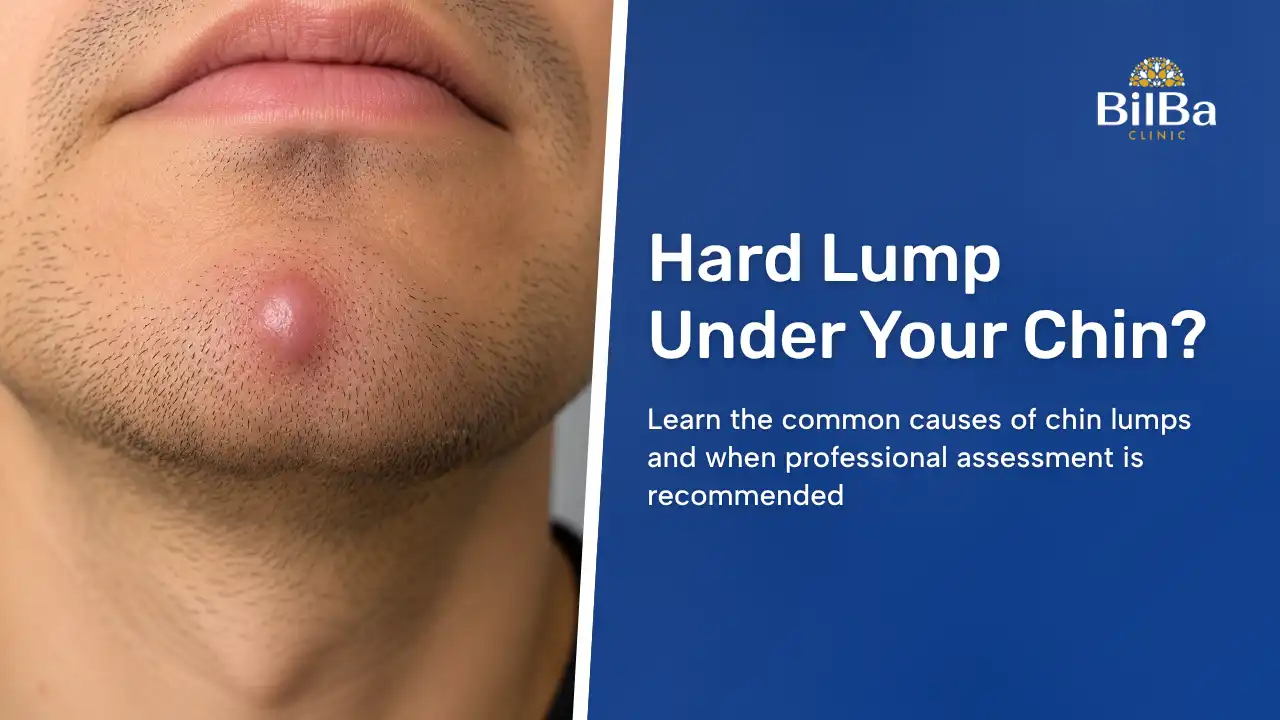
Finding a lump under chin can stop you in your tracks. You might notice it while shaving, washing your face, or simply resting your hand against your jaw. For most people, the first instinct is to press it, squeeze it, or hope it disappears overnight. It rarely does. And squeezing almost always makes things worse. At Bilba Clinic, we see patients regularly who have been managing a chin lump for weeks or months before seeking help. The good news is that most lumps under the chin are entirely benign. But understanding what you are dealing with, and getting a proper assessment, makes a significant difference to how quickly and comfortably it can be resolved.
Why a Lump Under Chin Appears in the First Place
The chin and jawline sit above a busy network of structures including oil glands, hair follicles, salivary glands, lymph nodes, and connective tissue. Any one of these can produce a visible or palpable growth when it becomes blocked, inflamed, or overactive. A bump on chin under skin does not always mean infection or anything serious. It simply means something beneath the surface has changed.
Age, skin type, shaving habits, and hormonal shifts all influence how prone you are to developing these growths. Men who shave regularly are particularly susceptible to ingrown hair cysts along the chin and jawline. Women may notice hormonal cysts flaring around the chin in line with their menstrual cycle. Neither is dangerous, but both can become problematic without the right management.
What a Lump Under Skin on Chin Actually Feels Like
Not all chin lumps behave the same way. Texture, depth, and tenderness vary considerably depending on the underlying cause. Getting familiar with what you are feeling helps you describe it accurately to a clinician and understand what questions to ask.
Hard Lump Under Skin on Chin
A hard lump under skin on chin is one of the most common presentations we assess. It typically feels firm and smooth, moves slightly when pressed, and sits just beneath the surface. This profile is consistent with a mature epidermoid cyst, a fibrosed nodule, or a calcified growth. Hard lumps that feel fixed to deeper tissue rather than mobile are worth assessing sooner rather than later.
Soft Lump Under Chin
A soft lump under chin usually feels doughy or rubbery and compresses gently under pressure. This texture is characteristic of a lipoma, which is a benign collection of fatty tissue that develops between the skin and the muscle layer. Lipomas are almost always harmless and grow slowly, but they can increase in size over time and become noticeable.
Cyst on Chin Under Skin
A cyst on chin under skin often has a slightly visible white or yellowish tinge beneath the surface. It may feel tender when pressed, particularly if it has become mildly inflamed. Epidermoid and pilar cysts are the most frequent types in this area. They develop when skin cells or keratin become trapped in a sac beneath the surface. Without removal of the entire sac, they tend to recur.
The Real Reason Squeezing Makes a Lump Under Skin on Chin Worse
This is the part most people learn the hard way. Squeezing or picking at a lump under skin on chin does not empty it in the way squeezing a spot might. Most chin lumps sit in an enclosed sac beneath the skin. Applying external pressure forces the contents deeper into surrounding tissue rather than clearing them. This triggers an inflammatory response, which causes swelling, redness, and pain far beyond what was there originally.
In some cases, the sac ruptures internally, spilling its contents into the surrounding tissue. When this happens, the body treats those contents as a foreign substance and mounts an immune response. The result is a significantly larger, more painful, and harder to treat lump than the one you started with. Infection can also set in, sometimes requiring antibiotics before any removal procedure is even possible.
Never squeeze, press firmly, or attempt to drain a lump under skin on chin. This consistently worsens outcomes and complicates treatment.
If a lump has already been squeezed and is now inflamed, our private GP services can assess it quickly and advise whether any initial treatment is needed before surgical removal is considered.
Painful Lump Under Chin and What It Usually Means
Pain changes the picture. A painful lump under chin suggests active inflammation, pressure on local nerves, or a developing infection. It does not automatically indicate anything sinister, but it does mean the growth needs attention rather than observation.
Painful Lump on Jawline
A painful lump on jawline often develops when a cyst or follicular blockage becomes irritated through shaving, friction from clothing, or secondary infection. The jawline is a common site for ingrown hairs, particularly in men, and these can evolve into tender, persistent nodules if not properly managed.
Painful Lump Under Chin Near Throat
A painful lump under chin near the throat warrants prompt assessment. This area contains lymph nodes that respond to infection and inflammation elsewhere in the body. A temporarily swollen lymph node following a cold or dental issue is common and usually resolves within a few weeks. A node that persists beyond three to four weeks, continues to grow, or feels hard and immovable should be reviewed by a clinician without delay. The NHS advises that swollen glands lasting more than two weeks should always be checked by a doctor.
When a Lump Under Jawline Needs Professional Attention
Most chin and jawline lumps do not require emergency care, but certain signs indicate that waiting is not the right approach. Use the following as a guide.
You should seek a professional assessment if:
- The lump has been present for more than two to three weeks without improvement
- It is growing noticeably in size week on week
- The skin over the lump looks red, feels warm, or begins to break down
- You notice the lump feels fixed rather than mobile when you press it
- A previously painless lump under chin has recently become tender or sore
- You experience difficulty swallowing or notice any change in your voice
None of these signs necessarily indicates something serious, but each one justifies a proper clinical examination rather than continued self-monitoring.

How We Assess a Lump Under Skin on Chin at Bilba Clinic
Diagnosis begins with a thorough consultation. Our clinician will examine the lump in good lighting, assess its size, depth, texture, and mobility, and ask about how long it has been present, whether it has changed, and any associated symptoms. Most diagnoses are made clinically without the need for imaging.
If the lump sits unusually deep, feels atypical, or is located near important structures along the jawline, a high-frequency ultrasound scan may be recommended before any procedure. This ensures precision and rules out anything that requires further investigation. Our plastic surgery and minor skin surgery teams work closely together to ensure every patient receives the most appropriate care pathway for their specific presentation.
Chin Lump Removal at Our Private Clinic
Treatment depends entirely on what the lump is, how large it is, and whether it is causing symptoms. The vast majority of chin lumps are removed as a straightforward day-case procedure under local anaesthetic.
What the Procedure Involves
A fine needle delivers local anaesthetic to the area, ensuring you feel comfortable throughout. Once numb, the clinician makes a small, precise incision, carefully separates the growth from surrounding tissue, and removes it in full. For cysts, complete removal of the entire sac is essential to prevent recurrence. The wound is closed with fine sutures and dressed before you leave.
Most chin lump removal procedures take between twenty and forty minutes. You can return home the same day and resume most normal activities within twenty-four to forty-eight hours. Sutures are typically removed within five to seven days.
Recovery and Aftercare
Mild swelling and tenderness around the chin are expected for the first couple of days. Keeping the area clean and dry, avoiding shaving directly over the wound, and protecting the site from direct sun exposure all support clean healing. If the removed tissue is sent for laboratory analysis, which is a routine precaution for certain growths, results are typically available within seven to ten working days and discussed with you directly.
Skin Lump Removal Cost and What to Expect
Skin lump removal cost at a private clinic depends on the size and complexity of the growth, the technique required, and whether a diagnostic consultation is included. At Bilba Clinic, we provide transparent pricing before any procedure takes place so you are never faced with unexpected charges. You can review our current pricing online or ask our reception team for a breakdown during your consultation.
We accept major private medical insurers including Bupa, Vitality, and WPA. Our team can provide the clinical documentation required to support your insurance claim.
Thinking About Getting a Lump Under Skin on Chin Checked
If you have been monitoring a chin lump and are unsure whether to act, the straightforward answer is that early assessment leads to simpler treatment. A lump that is dealt with before it becomes inflamed or infected is far easier to remove, heals more quickly, and carries a lower risk of visible scarring.
Our team at Bilba Clinic offers unhurried consultations in a calm, CQC-registered environment in Fitzrovia. We will explain exactly what you are dealing with, outline your options clearly, and let you decide on the right course of action at your own pace. If you are ready to get a clear answer, you can book your appointment online today.
Frequently Asked Questions About Lump Under Chin
Why is there a hard lump under skin on chin?
A hard lump under skin on chin is most commonly an epidermoid cyst, a fibrosed nodule, or an ingrown hair that has developed into a deeper growth. It forms when skin cells, keratin, or sebum become trapped beneath the surface. Hard lumps that are mobile and painless are usually benign, but any growth that feels fixed or changes quickly should be assessed by a clinician.
Can a painful lump under chin be cancer?
The vast majority of painful lumps under the chin are caused by benign conditions such as infected cysts, inflamed lymph nodes, or irritated follicles. Pain itself is not a reliable indicator of anything sinister. That said, any lump that persists beyond three to four weeks, grows rapidly, or feels hard and immovable should always be reviewed professionally to rule out anything that requires further investigation.
Is a lump under jawline dangerous?
Most lumps under the jawline are entirely harmless. Cysts, lipomas, and reactive lymph nodes account for the overwhelming majority of cases. A lump becomes a greater clinical concern when it grows quickly, feels fixed to deeper tissue, causes difficulty swallowing, or does not respond to treatment for an underlying infection.
How long does a lump under chin last?
This depends on the cause. A reactive lymph node following a cold or throat infection typically resolves within two to four weeks. A cyst or lipoma will not resolve on its own and tends to remain stable or slowly grow over time. If a lump has been present for more than three weeks without any change, a clinical assessment is advisable.
What does a cyst on chin under skin feel like?
A cyst on chin under skin typically feels smooth, slightly mobile, and rounded. It may have a soft or firm consistency depending on how long it has been there and whether it has become inflamed. Some cysts have a visible whitish or yellowish tinge beneath the skin surface. Inflamed cysts feel warm, tender, and may appear red.
How much does skin lump removal cost at a private clinic?
Skin lump removal cost varies depending on the size, type, and complexity of the growth. At Bilba Clinic, pricing is transparent and discussed in full before any procedure takes place. You can view our current fees on our pricing page or speak to our team directly when you book a consultation.