
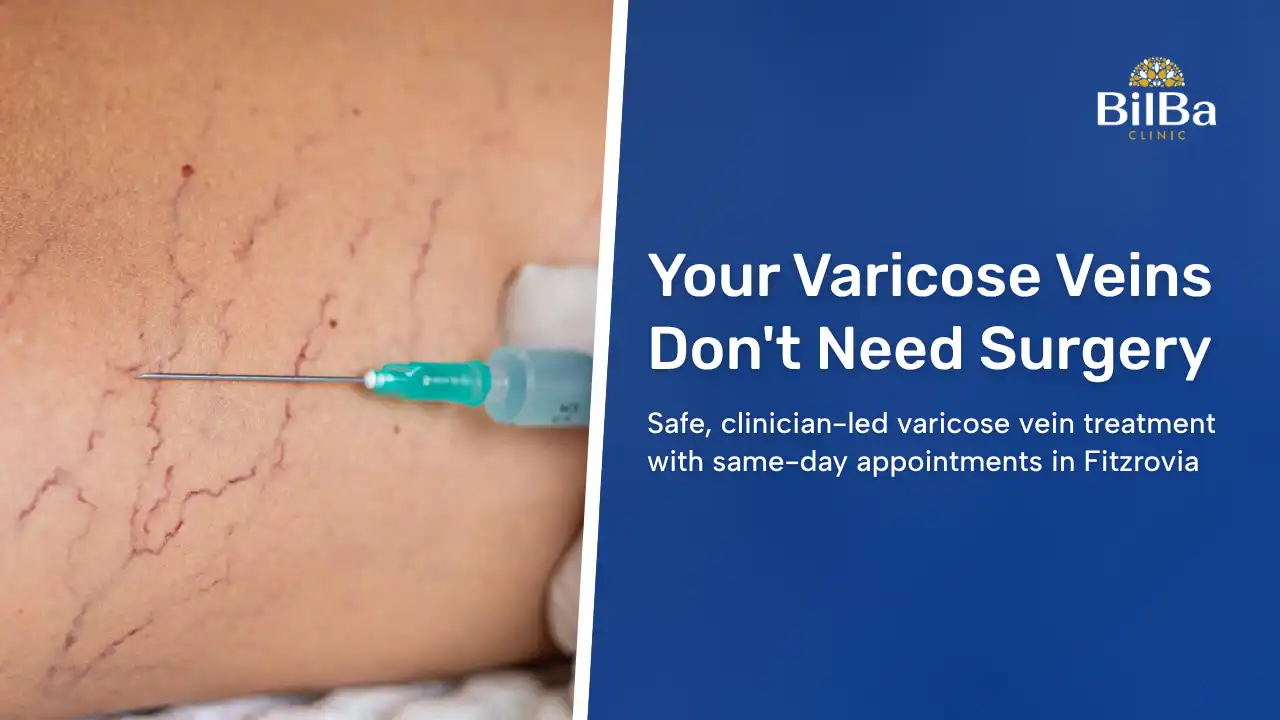
If you have noticed bulging, ropy veins running along your calves or thighs, you are not alone. Varicose veins affect a significant proportion of adults across the UK, and for many people, the thought of an operation is enough to put them off seeking help altogether. What many patients do not realise is that surgery has not been the only option for quite some time.
Foam sclerotherapy is a clinically established, minimally invasive treatment that has helped thousands of patients manage varicose veins without setting foot in an operating theatre. In this guide, we walk you through what the condition actually involves, how foam sclerotherapy works, who it is right for, and what you can realistically expect at every stage of the process.
What Are Varicose Veins and Why Do They Develop
Your veins rely on a series of small one-way valves to push blood back up towards your heart against the force of gravity. When those valves weaken or stop functioning properly, blood begins to pool and collect within the vein. Over time, the pressure causes the vein to stretch, swell and become visible beneath the surface of the skin.
Several factors can increase your likelihood of developing varicose veins. A family history of the condition is one of the strongest predictors. Beyond genetics, prolonged standing, pregnancy, older age, being overweight and a sedentary lifestyle all play a role. It is worth noting that varicose veins are a recognised medical condition with real physical consequences, not simply a cosmetic inconvenience.
If you are concerned about your circulation more broadly, our Private GP Services can help you get an initial assessment and onward referral to our vascular team where needed.
The Symptoms That Suggest Something Needs Attention
Not everyone with varicose veins experiences discomfort. However, when symptoms do appear, they can gradually affect your mobility, sleep and overall quality of life. Many patients describe a dull aching or heaviness in their legs that worsens as the day goes on. Others notice swelling around the ankle, an itching or burning sensation along the vein, cramping during the night, or a feeling of restlessness in the legs.
You should seek a medical assessment sooner rather than later if you notice any of the following:
- Skin that is darkening, hardening or becoming discoloured near the ankle
- A wound or ulcer on the lower leg that is not healing as expected — our Wound Management service can support this alongside vascular treatment
- Sudden redness, swelling or warmth in the leg, which can indicate a clot and requires urgent medical attention
- Veins that bleed with very little provocation
- Pain that is limiting your normal daily activities
These signs suggest the condition has progressed beyond a surface-level concern. If any of these sound familiar, we can assess this quickly and help you understand exactly what is happening. The sooner you are seen, the more straightforward your treatment pathway is likely to be.
For patients who also have diabetes and are experiencing foot or leg complications, our specialist Diabetic Foot Care service works alongside vascular assessment to manage complex presentations safely.
How Varicose Veins Are Properly Assessed Before Treatment
A thorough assessment is essential before any treatment is recommended. Treating varicose veins without understanding the underlying cause is not good medicine, and it is not something we do at Bilba Clinic.
We use an Ultrasound Vascular Doppler scan to assess blood flow through your veins and map exactly where the valves are failing. This is a completely non-invasive scan carried out in clinic, and it gives us a detailed picture of your vascular health before we recommend anything. Without it, any treatment plan would be based on guesswork rather than clinical evidence.
We offer on-site vascular assessment, which means you can have your Doppler scan and your consultation at the same appointment rather than being sent elsewhere. You can find out more about what our vascular assessment and diagnostic services involve on our General and Vascular Surgery page.
What Foam Sclerotherapy Actually Is and How It Works
Foam sclerotherapy is an injection-based treatment for varicose veins. A carefully prepared foam solution, known as a sclerosant, is injected directly into the affected vein. The foam works by irritating the inner wall of the vein, causing it to swell, seal shut and gradually be absorbed by the surrounding tissue. Over the weeks that follow, the treated vein fades from view and the symptoms it was causing begin to resolve.
The foam formulation is considered more effective than traditional liquid sclerotherapy for larger varicose veins because foam actively displaces the blood within the vein. This means the sclerosant stays in contact with the vein wall for longer and over a greater surface area, improving the clinical outcome.
When we carry out ultrasound-guided foam sclerotherapy, the entire procedure is directed using live ultrasound imaging. This is particularly important for veins that sit deeper beneath the skin or that are not easily visible from the outside. Ultrasound guidance allows us to be precise, and precision matters when it comes to vascular treatment.
Here is what a typical session involves:
- A pre-treatment consultation and Doppler assessment to confirm suitability
- The sclerosant foam is carefully prepared to the correct concentration
- Ultrasound is used to locate and visualise the target vein in real time
- The foam is injected through a fine needle with minimal discomfort
- Compression stockings are applied to the treated area immediately afterwards
- You are encouraged to walk before leaving the clinic and can return to most normal activities the same day
There is no general anaesthetic required, no surgical incisions, and no hospital admission.
How Foam Sclerotherapy Compares to Other Varicose Vein Treatments
It is entirely reasonable to want to understand all your options before committing to a treatment. In the UK, several approaches are currently used for varicose veins, each with its own indications, advantages and limitations.
Foam Sclerotherapy vs Endovenous Laser Ablation (EVLA)
Both foam sclerotherapy and EVLA are minimally invasive and widely used in private vascular clinics across the UK. EVLA uses laser energy delivered through a thin catheter to seal larger trunk veins, typically the great saphenous vein. Foam sclerotherapy is generally better suited to smaller and medium-sized varicose veins and branch vessels.
| Foam Sclerotherapy | EVLA | |
|---|---|---|
| Method | Foam injection via fine needle | Laser via catheter under ultrasound |
| Anaesthetic | Minimal or none | Local anaesthetic |
| Best suited for | Small to medium varicose veins | Larger trunk veins |
| Typical recovery | 1 to 2 days | 3 to 5 days |
| Sessions needed | Often 1 to 3 | Usually 1 |
Both treatments are available at Bilba Clinic. You can view the full range of our vascular surgery services, including EVLA and ultrasound vascular Doppler assessment, on our General and Vascular Surgery page.
Foam Sclerotherapy vs Traditional Surgery (Vein Stripping)
Surgical vein stripping involves physically removing the vein through incisions under general anaesthetic. It was once the standard treatment but has been largely replaced by minimally invasive options in both NHS and private settings. The National Institute for Health and Care Excellence (NICE) guidelines now recommend endovenous treatments as the first-line approach where suitable.
Foam sclerotherapy and EVLA both sit within the NICE-recommended pathway. A number of well-known UK private providers offer these treatments. Where Bilba Clinic differs is in combining on-site Doppler assessment, experienced vascular clinicians, a CQC-regulated environment, and genuinely personalised treatment planning — all under one roof in Central London, with same-day appointments available in many cases.
When Surgery Might Still Be the Right Answer
We want to be straightforward with you here. Foam sclerotherapy is not suitable for every case, and not every patient who wants it will be a candidate. In some situations, particularly where the great saphenous vein is severely refluxing or where anatomy is complex, EVLA or a surgical approach may give better long-term results. We will always tell you honestly at your consultation which route is most appropriate for your individual circumstances.
Who Is Likely to Benefit from Foam Sclerotherapy
This treatment tends to work well for adults who have small to medium varicose veins causing symptoms such as aching, heaviness, swelling or visible surface changes. It is also a good option for people who want to avoid surgery or general anaesthetic, and for those whose Doppler scan confirms venous reflux in the treated vessel.
Patients who have previously had vein surgery and are now experiencing recurrent varicose veins are also often suitable candidates for foam sclerotherapy, as it can be used to address residual or recurring vessels that surgery left behind.
If you are managing your weight as part of your overall health excess weight being a known contributing factor to varicose veins, our Weight Loss Management service and Nutrition Coaching are available to support you alongside your vascular treatment.
Who May Not Be Suitable for This Treatment
Not everyone is a candidate, and responsible clinical care means being upfront about this. Foam sclerotherapy is generally not appropriate during pregnancy, for patients with a confirmed or suspected history of deep vein thrombosis, those with significant arterial disease affecting the leg, or individuals with a known allergy to the sclerosant agent.
Very large or complex vein anatomy, or cases where the underlying cause of reflux has not been addressed, may also mean a different treatment is recommended. This is precisely why the initial consultation and Doppler assessment matter so much before any decision is made.
An Honest Look at the Risks and Side Effects
Like any medical procedure, foam sclerotherapy carries risks. We believe patients make better decisions when they are given accurate information, not just the reassuring parts.
Common side effects, usually mild and temporary, include:
- Bruising and tenderness around the injection site
- Temporary brown skin staining (post-inflammatory hyperpigmentation), which can take several months to fully fade in some patients
- Minor swelling or itching in the treated area
- Matting, which refers to the appearance of small new superficial vessels near the treated vein
Less common but clinically important risks include:
- Thrombophlebitis, which is inflammation and clotting within the treated vein, causing temporary pain and firmness
- Transient visual disturbances, which are uncommon but are thought to be related to the foam reaching the circulation and are usually brief and self-resolving
- Skin ulceration at the injection site, which is rare
- Deep vein thrombosis, which is rare but serious, and is why pre-treatment screening and compression are both important
At Bilba Clinic, every procedure is carried out by an experienced vascular clinician in a CQC-registered setting. Your safety underpins every decision we make, from patient selection through to aftercare.
If you have any concerns about circulation or cardiovascular risk factors ahead of treatment, our Private GP Services team can carry out a Health Screening or relevant Pathology tests to ensure you are well prepared before your vascular consultation.
What Recovery Looks Like After Foam Sclerotherapy
Most patients leave the clinic the same day and are able to return to light normal activities within 24 to 48 hours. You will be asked to wear a compression stocking for a period after treatment, typically one to two weeks, which supports the vein and reduces the risk of complications.
During the initial recovery period, we advise avoiding hot baths and saunas, intense physical exercise, and long-haul air travel. You may notice some firmness and mild bruising along the treated vein, both of which are a normal part of the healing process.
Results appear gradually rather than immediately. As the body absorbs the closed vein over several weeks, you will notice the vein becoming less visible and the associated symptoms beginning to settle. Most patients see the full benefit of treatment within two to three months.
Depending on the number and size of the veins being treated, more than one session may be needed. Most patients require between one and three sessions, spaced around six to twelve weeks apart. We will advise you on the likely number of sessions at your initial consultation based on your Doppler scan findings and clinical assessment.
Our Physiotherapy team is also available if you would like support returning to activity safely after your treatment, particularly if leg pain or swelling has affected your movement in the period leading up to your procedure.

Foam Sclerotherapy in London at a Regulated Private Clinic
If you are looking for experienced, CQC-regulated care in Central London, we are based in Fitzrovia, close to Oxford Street, Great Portland Street and Warren Street stations. You can book a same-day appointment in many cases, have your Doppler assessment completed on site, and begin your treatment plan without delay.
Private treatment means you are not waiting months for an NHS referral to come through. You are assessed by a specialist, given a clear diagnosis, and given a treatment plan that is built around you and your lifestyle, not a waiting list.
For a full breakdown of what each treatment and consultation involves, please visit our Pricing page before you book, so you have complete clarity before your first appointment.
Questions Patients Commonly Ask About Foam Sclerotherapy
Is foam sclerotherapy painful?
Most patients describe a mild stinging or pressure sensation during the injection. It is not typically described as significantly painful, and no general anaesthetic is needed. If you are concerned about discomfort, this is worth raising with your clinician at your consultation.
How long does each session take?
A typical treatment session lasts between 30 and 45 minutes, including preparation and the application of compression stockings afterwards.
Will the veins return after treatment?
Veins that have been successfully treated with foam sclerotherapy are permanently closed and gradually absorbed by the body. However, new varicose veins can develop over time, particularly if the underlying risk factors — such as prolonged standing or weight — remain unchanged. Follow-up care helps to monitor this over time.
Do I need a GP referral to be seen at Bilba Clinic?
No. You can book directly with us without a referral from your GP. Our team will guide you from your initial enquiry through to your assessment and treatment plan.
Can foam sclerotherapy be used on spider veins?
Spider veins and thread veins are typically treated with liquid sclerotherapy or surface laser rather than foam. Foam sclerotherapy is primarily used for larger varicose veins where greater contact with the vein wall is needed. We also offer sclerotherapy for surface thread and spider veins as part of our aesthetic services if that is more relevant to your situation.
How does foam sclerotherapy compare to what is available on the NHS?
NICE guidelines recommend endovenous treatments as the first-line approach for varicose veins, and foam sclerotherapy is one of the options within that pathway. NHS waiting times for vascular treatment can be significant in many areas of the UK, and the range of procedures available may vary by trust. Private treatment at Bilba Clinic allows you to be assessed and treated more promptly, by a specialist, with greater continuity of care throughout the process.
Does Bilba Clinic accept health insurance?
Bilba Clinic is recognised by a number of private health insurers including Bupa. If you intend to use insurance, we recommend contacting your insurer before booking to confirm your cover. Our Contact Us team can advise you further.
What to Do If Your Varicose Veins Are Affecting Your Life
Living with aching, swollen or visibly prominent varicose veins does not have to be your baseline. You do not need to wait until the symptoms become severe, and you do not need to consider surgery before exploring other effective, evidence-based options.
At Bilba Clinic, we take the time to properly assess your veins, explain your findings in plain language, and guide you towards the treatment pathway that genuinely fits your situation. We will not recommend a procedure unless the clinical evidence supports it and unless it is right for you individually. If foam sclerotherapy is not suitable for your case, we will tell you clearly and discuss what is — whether that means EVLA, a different surgical approach, or another pathway entirely.
If your legs have been bothering you, or you have noticed changes you are unsure about, we can help you understand what is going on. A consultation with our vascular team is the natural first step, and it takes the uncertainty out of the process entirely.
You can book a vascular consultation directly online or call us on +44 (0) 7858 848 244. You can also explore our full range of vascular and surgical services to understand everything we offer before your first visit.
We are here to help you take that first step with confidence.