
Most people assume knee osteoarthritis means one thing, a knee that hurts. That’s true, but it’s only part of the picture. Stiffness in the morning, a grinding feeling when you climb stairs, swelling that comes and goes, even weakness that makes the knee feel unreliable, all of these are knee osteoarthritis symptoms too. Recognising them early makes a real difference to how the condition is managed, partly because it opens up more treatment options and partly because it stops months of discomfort being written off as ordinary ageing. This guide covers the full range of signs, how they change as the condition develops, and what actually helps once you know what you’re dealing with.
What Is Knee Osteoarthritis
Knee osteoarthritis is what happens when the smooth cartilage covering the ends of the bones in your knee gradually wears down. That cartilage normally lets the joint move without friction, cushioning each step you take. Once it thins, bone can start to sit closer to bone, and the joint becomes less able to absorb the small, everyday forces it’s built to handle. It’s the most common form of arthritis in the UK, and the knee is one of the joints it affects most, alongside the hips and the small joints of the hands.
Age plays a role, but it isn’t the whole story. Previous injuries, years of heavy manual work, carrying extra weight, and simple genetics all contribute to how early and how severely someone develops it. Some people reach their seventies with barely any joint changes, while others notice clear symptoms in their forties, which is why two people doing the same job for the same number of years can end up with very different knees.
Signs of Knee Osteoarthritis
Knee osteoarthritis signs vary from person to person, and the same person can notice different symptoms depending on the day. Knee osteoarthritis pain rarely shows up on its own, it usually arrives alongside at least one of the other signs below, which is part of what separates it from a simple muscle strain or a one-off twinge.
- Pain around or just below the kneecap, or along the inner or outer joint line
- A grinding, crunching or clicking sensation called crepitus when bending or straightening the knee
- Reduced range of motion, particularly difficulty fully bending or straightening the leg
- A feeling that the knee might give way under weight, especially on stairs
What is osteoarthritis knee pain like in practice? Usually an ache around the joint line, sometimes at the front, sometimes to one side, that builds with activity and eases with rest, at least in the earlier stages. What does osteoarthritis in the knee feel like beyond the pain itself is often just as telling, a heaviness or stiffness that makes the knee feel less dependable even when it isn’t actively hurting.
Symptoms of osteoarthritis in the knee tend to build gradually rather than appear overnight, which is part of why so many people put them down to simply getting older rather than something worth getting checked. According to NHS guidance on osteoarthritis symptoms, pain and stiffness together are the two symptoms that bring most people in for an assessment in the first place. The two don’t always arrive together though, some people notice stiffness weeks or months before pain becomes a regular feature, which is worth keeping in mind if you’re trying to work out whether what you’re feeling fits the pattern.
Early Knee Osteoarthritis Symptoms
Early knee osteoarthritis symptoms are often easy to dismiss. A bit of stiffness after a long car journey. A twinge going down stairs that wasn’t there last year. Knee osteoarthritis symptoms in early stages tend to be mild, intermittent and closely tied to activity, present after a long walk, gone by the next morning, easy to blame on simply overdoing it.
Early signs of knee osteoarthritis are worth paying attention to precisely because they’re manageable at this point. Catching the condition while symptoms are still mild gives far more options, lifestyle changes, targeted exercise, weight management if relevant, than waiting until the joint has narrowed a lot further and pain has become a daily fixture rather than an occasional visitor.
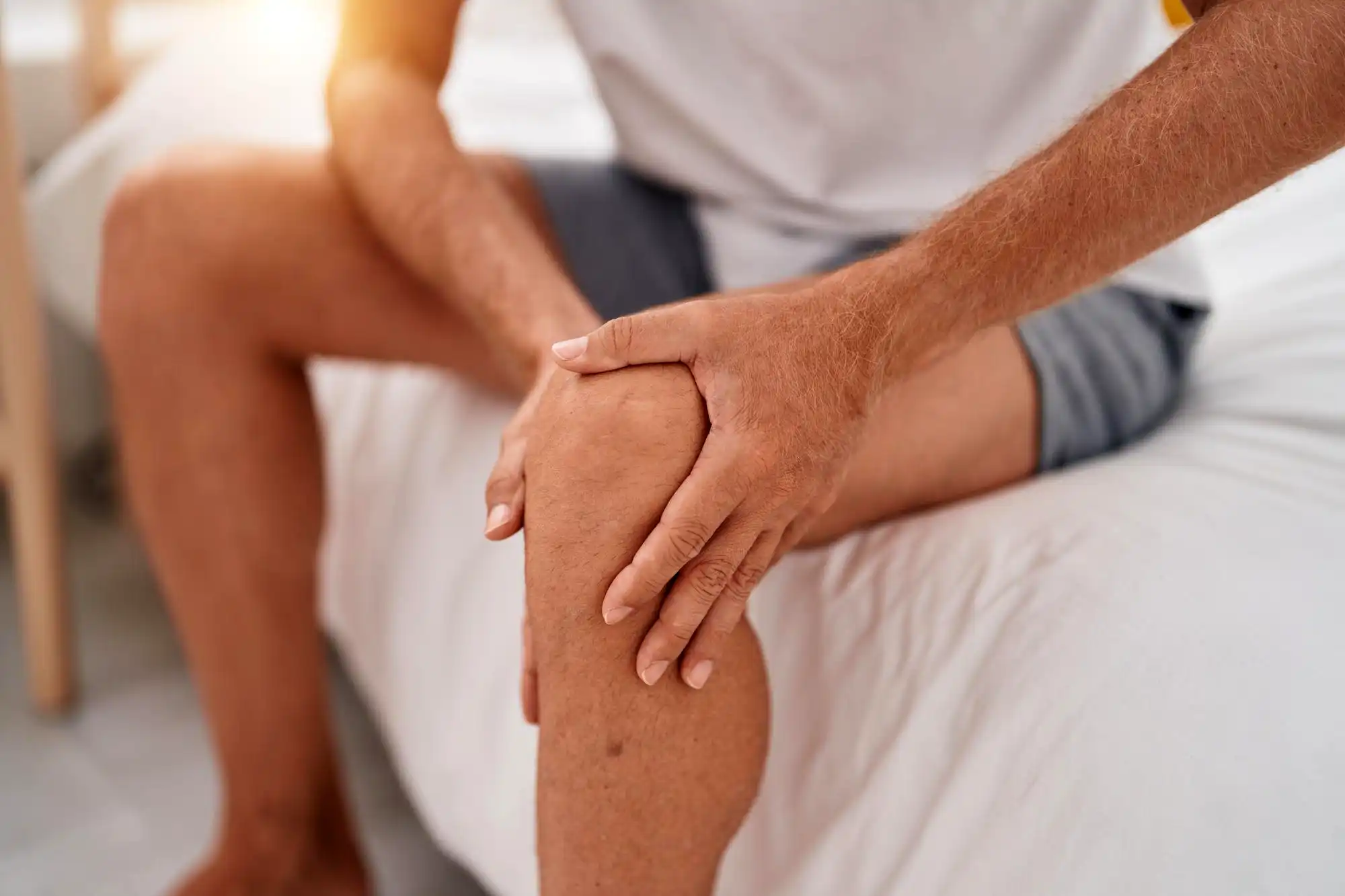
Stiffness, Swelling and Weakness
Pain gets most of the attention, but knee osteoarthritis stiffness is often what people notice first thing in the morning. It typically lasts under 30 minutes and eases once you start moving, which is a useful clue on its own, inflammatory joint conditions tend to cause stiffness that lasts considerably longer than that.
Knee osteoarthritis swelling happens because the joint reacts to ongoing wear with mild inflammation, sometimes producing extra fluid that makes the knee look or feel puffy. Can knee osteoarthritis cause swelling severe enough to be obvious? Yes, though it’s usually milder and comes and goes, unlike the more constant swelling seen in inflammatory joint conditions.
Weakness is an easy symptom to overlook, since it sounds more like a nerve problem than a joint one. Does knee osteoarthritis cause weakness is still a fair question to ask, and the answer is yes, indirectly. The muscles around a painful knee, particularly the quadriceps at the front of the thigh, often weaken simply because the joint gets used less and moved through a smaller range day to day. That weakness then makes the knee feel even less stable, which can turn into a cycle if it isn’t addressed with targeted strengthening work.
Crepitus in the knee, the grinding or crackling sound, deserves its own mention. It happens as roughened joint surfaces move against each other and is common enough on its own not to be alarming. It only really matters when it’s paired with pain or swelling, a completely silent, pain-free knee that occasionally clicks during a stretch is a different thing entirely from one that grinds noticeably every time you climb a flight of stairs.
Weakness and swelling also tend to reinforce each other in an unhelpful way. A swollen knee doesn’t bend as freely, so the surrounding muscles get used less, and those muscles then weaken further, which makes the joint feel even less supported. Breaking that cycle is usually less about treating any single symptom and more about restoring movement and strength together, which is exactly the kind of thing a proper assessment can guide.
What Does Knee Osteoarthritis Look Like
What does knee osteoarthritis look like from the outside? Often, not much at all, mild cases show no visible change whatsoever. More advanced cases can show visible swelling, a knee that sits slightly bent rather than fully straight, or muscle wasting around the thigh from reduced use over time.
Internally, the picture looks quite different, and this is where knee osteoarthritis x ray stages come in. Doctors commonly use the Kellgren-Lawrence scale to describe knee osteoarthritis stages from an X-ray.
| X-ray grade | What it shows |
| Grade 0 to 1 | Normal, or only doubtful narrowing with possibly the very earliest bone changes |
| Grade 2 | Clear small bony growths called osteophytes, with slight narrowing of the joint space |
| Grade 3 | Moderate narrowing with multiple osteophytes, sometimes with hardened bone visible at the joint edges |
| Grade 4 | Severe narrowing, larger osteophytes, and noticeable changes to the shape of the joint |
X-ray severity doesn’t always match how much pain someone reports, some people with major changes on a scan have relatively mild symptoms, while others with milder changes are in real discomfort. This is one of the reasons a scan is only ever part of the picture, how the knee actually behaves day to day carries just as much weight as what shows up on the image.
Symptoms at Night and in Younger Adults
Knee osteoarthritis symptoms at night are common and often frustrating. Around three in four people with hip or knee osteoarthritis report their pain feels worse at night, partly due to reduced movement and blood flow changes during rest, and partly because there are simply fewer distractions from it once you’re lying still with nothing else to focus on.
Knee osteoarthritis symptoms in younger adults are less common but far from rare. While risk climbs sharply after 45, a previous knee injury, a torn ligament, a fracture near the joint, or repeated strain from certain sports can bring on osteoarthritis decades earlier than the typical age-related pattern. If you’re under 40 and dealing with knee symptoms that sound like the ones covered here, a past injury is worth mentioning to whoever assesses you. Footballers, rugby players and anyone who’s had a serious ligament tear all carry a higher risk of developing changes in that same knee years later, even after the original injury seemed to heal completely at the time.
Can You Have Knee Osteoarthritis Without Pain
Yes, and it’s more common than most people expect. Can you have knee osteoarthritis without pain in the early stages particularly? Some people notice stiffness or a grinding sensation well before pain becomes a regular feature. Others have clear changes visible on an X-ray with barely any symptoms at all, going about daily life without much bother despite what the scan would suggest. This mismatch between what a scan shows and what a person actually feels is one of the more puzzling parts of this condition, and it’s exactly why a proper assessment matters more than trying to work things out from a single symptom alone.
How Quickly Symptoms Get Worse
Knee osteoarthritis symptoms getting worse over time is the general pattern, but how quickly does knee osteoarthritis progress varies enormously between people. For some, changes happen gradually over many years, barely noticeable from one year to the next. For others, particularly after an injury or with ongoing joint strain, symptoms can worsen within just a few years. Weight, activity levels, muscle strength around the joint and how early treatment starts all influence the pace, which is why two people diagnosed at the same time can have very different experiences five years on.
How to Tell If Knee Pain Is Osteoarthritis
How to tell if knee pain is osteoarthritis rather than something else starts with the pattern it follows. Osteoarthritis pain tends to build with activity and ease with rest, usually affects one knee more than the other, and comes with the stiffness and crepitus already covered above.
Osteoarthritis vs rheumatoid arthritis knee is a distinction worth understanding, since the two are managed quite differently.
- Cause: osteoarthritis comes from knee joint degeneration and cartilage wear in the knee, rheumatoid arthritis is an autoimmune condition
- Pattern: osteoarthritis usually starts on one side, rheumatoid arthritis tends to affect both knees symmetrically
- Swelling and warmth: more pronounced and constant in rheumatoid arthritis, milder and variable in osteoarthritis
- Speed: rheumatoid arthritis typically progresses faster than osteoarthritis
- Blood tests: rheumatoid arthritis often shows raised inflammatory markers, osteoarthritis typically doesn’t
None of this replaces a proper assessment, but it gives a reasonable starting point for telling the two apart before you ever see a clinician.
Is Cycling Good for Knee Osteoarthritis
Is cycling good for knee osteoarthritis? The evidence says yes, and fairly strongly. Cycling loads the knee far less than walking, running or stair climbing, while still working the muscles that support the joint. Research following regular cyclists has found lower rates of both knee pain and X-ray-confirmed osteoarthritis compared with non-cyclists, and low-intensity cycling appears to work about as well as harder sessions for easing pain and improving function. It’s one of the few cases where an activity that feels gentle is backed by solid evidence, rather than being a compromise people settle for once running is off the table.
Starting with short, frequent sessions on flat ground and building up gradually tends to work better than jumping straight into long rides, particularly if the knee has been painful for a while and the surrounding muscles have weakened. A stationary bike can be a useful starting point too, since it removes balance and terrain from the equation entirely.

Get Your Knee Osteoarthritis Assessed at Bilba Clinic
Osteoarthritis knee joint treatment isn’t one single thing, it’s usually a combination built around your specific symptoms and how far the condition has developed. What is the treatment for knee osteoarthritis in most cases starts with physiotherapy-led exercise, weight management where relevant, and pain relief, since these have the strongest evidence behind them for slowing symptoms and keeping the joint functional over the long run. None of these are quick fixes, but they’re the options most likely to make a lasting difference rather than simply masking discomfort for a few weeks at a time.
For knees that haven’t responded well to the basics, joint injections for osteoarthritis knee pain are worth discussing with our medical services team, and PRP knee osteoarthritis treatment, offered through our regenerative medicine service, is one of the non-surgical routes we can talk you through. Surgical treatment for knee osteoarthritis, ranging from smaller procedures to a full knee replacement, tends to be reserved for cases where the joint is badly worn and conservative options haven’t given enough relief after a genuine trial. If joint pain in general is something you’ve been dealing with beyond the knee, our guide to joint pain near the tendons covers a related but different pattern that’s worth ruling out too.
Making a decision about knee osteoarthritis treatment doesn’t need to happen in one sitting, and it shouldn’t feel rushed given how many options are actually on the table. Our our team can walk you through the practical choices for your specific knee, what each one involves, and what a sensible next step looks like, rather than leaving you to work it out from a list of treatments online. If you’ve been searching for knee osteoarthritis treatment london, a knee specialist london, or a private knee clinic london, our Fitzrovia clinic brings assessment and treatment together under one roof, so you’re not sent elsewhere for a scan or a follow-up injection once your plan is agreed. Current pricing for consultations is available on our site. Book a consultation to get started, or contact us if you have questions first.
- Address: 57 Great Titchfield Street, Fitzrovia, London W1W 7PN
- Phone: +44 (0) 7858 848 244
- Email: info@bilbaclinic.co.uk
Opening hours: Monday to Friday 10:00 to 18:00,
Saturday: 12:00 to 17:00
Sunday: Closed
Frequently Asked Questions
Is Knee Osteoarthritis Just Normal Wear and Tear?
It’s closely linked to wear and tear, but calling it “just” that undersells it. The cartilage loss is real and progressive, and while it’s extremely common with age, it’s still a joint condition worth managing properly rather than accepting as an unavoidable part of getting older.
Can Knee Osteoarthritis Be Reversed?
No, the cartilage changes themselves aren’t reversible with current treatments. What can actually improve is pain, function and how much the condition limits daily life, which is where exercise, weight management and the treatments covered above make a real, measurable difference.
Should I Stop Exercising If My Knee Hurts?
Generally no, though the type of exercise matters. Low-impact activity like cycling or swimming tends to help rather than harm an osteoarthritic knee, while high-impact activities may need adjusting or reducing. Stopping activity altogether often makes things worse over time by weakening the muscles that support the joint.
When Should I See a Doctor About Knee Pain?
If pain, stiffness or swelling has lasted more than a few weeks, is affecting your daily activities, or keeps disturbing your sleep, it’s worth getting assessed rather than waiting to see if it settles on its own. The same goes for a knee that suddenly locks, gives way repeatedly, or swells up a lot right after a specific twist or fall, since those signs point to something that needs a closer look sooner rather than later.