A drip bag and a comfortable chair don’t look like much, but vitamin IV drip therapy has become one of the more talked-about ways to top up hydration and nutrients quickly. Some of that reputation is deserved. Some of it is marketing running ahead of the research. This guide covers what an IV vitamin drip actually contains, what it can actually do for energy and hydration, where the evidence gets thin, and what a session at Bilba Clinic involves from start to finish. By the end you should have a clear picture of whether it’s worth trying for your own situation, not just a list of ingredients and a price tag.
What Is Vitamin IV Drip Therapy
What is IV drip therapy at its most basic? It’s a way of delivering fluids, vitamins and minerals directly into a vein, bypassing the digestive system entirely. Intravenous vitamin therapy has been used in medical settings for decades, originally for patients who couldn’t absorb nutrients properly through food, and it’s since been adapted into a wellness treatment for people without that underlying problem.
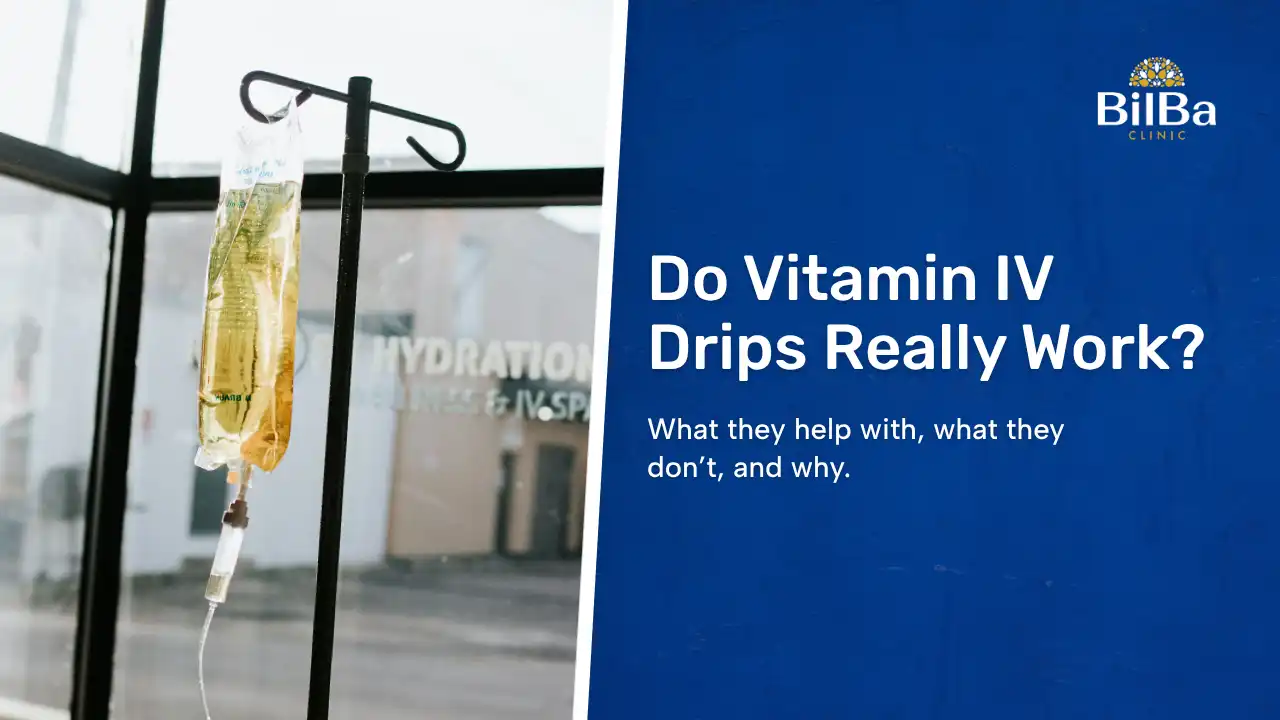
How does IV vitamin therapy work in practice? A small cannula is placed in a vein, usually in the arm, and a bag of sterile fluid containing your chosen blend of vitamins and minerals drips in slowly over the course of the appointment. A trained clinician stays on hand throughout, checking the flow rate and how you’re responding, rather than leaving you plugged in unattended. Because the nutrients skip the gut, absorption is close to complete rather than limited by whatever your digestive system decides to let through on a given day. That’s the whole appeal in a sentence, and also the reason it costs more than a bottle of supplements.
Vitamin infusion therapy of this kind is generally well tolerated, though as with anything involving a needle and a vein, it isn’t entirely without risk, which we’ll get to further down. It’s worth knowing upfront that this is a medical procedure delivered in a clinical setting, not a lifestyle product you’d pick up at a pharmacy counter.
What’s Actually in a Vitamin IV Drip
What vitamins are in an IV drip depends on which blend you choose, but most formulas are built around a similar core. The original template, and still the most widely used, is the myers cocktail IV drip, developed decades ago by a Baltimore physician and still forming the basis of most IV nutrient therapy blends sold today.
- Vitamin C, usually in gram doses well above what you’d get from food or a standard supplement
- A B-complex blend covering B1, B2, B3, B5, B6 and B12, involved in energy metabolism and nervous system function
- Magnesium, which plays a role in muscle function, nerve signalling and blood sugar regulation
- Calcium, typically included as calcium gluconate for bone and muscle support
Beyond the core Myers formula, clinics often adjust the blend for a specific goal, adding glutathione for skin clarity, extra B12 for energy, or higher-dose vitamin C for immune support. We’ve written more on what the Myers cocktail actually does if you want the full breakdown.
The saline base itself matters more than people expect. It’s not just a carrier fluid, it’s also doing the hydration work, replacing lost fluid volume alongside whatever vitamins are dissolved in it. That’s part of why a drip can feel noticeably different from taking the same nutrients as a tablet, you’re getting rehydrated and topped up on nutrients in the same sitting, rather than one without the other.

Benefits of Vitamin IV Drip Therapy
IV vitamin therapy benefits are usually described in terms of energy, hydration and recovery, and there’s a reasonable physiological basis for at least two of those. Vitamin IV hydration therapy replaces fluid and electrolytes faster than drinking water alone, which matters if you’re truly dehydrated, after a heavy night, a bout of illness, or intense exercise. We cover this specific use in more depth in our guide on IV infusion for dehydration.
A vitamin drip for hydration also carries the B vitamins and minerals your body would normally get from food, so if you happen to be running low on one of them, correcting that shortfall through a drip works quickly. Vitamin drip for energy claims lean on this same logic, B vitamins really are involved in how your cells produce energy, but that’s a different claim from saying a drip will make an already well-nourished person feel more energetic, which is where the evidence gets shakier. Someone who’s actually deficient in B12 or another key nutrient often does notice a difference. Someone whose diet already covers those bases is unlikely to feel much beyond the effect of being well hydrated for a day or two.
Can IV Vitamin Therapy Help With Tiredness
Can IV vitamin therapy help with tiredness depends heavily on why you’re tired in the first place. If fatigue is coming from dehydration or an actual nutrient deficiency, correcting that deficiency through a drip can actually help, and often faster than waiting for oral supplements to catch up. If the tiredness has other causes, poor sleep, stress, an unrelated health condition, a drip isn’t going to fix what it isn’t targeting, no matter how good the ingredients list looks. Worth asking yourself honestly which category you fall into before booking, since it changes how much benefit you’re likely to see.
Does IV Vitamin Therapy Really Work
This is worth answering honestly rather than as a sales pitch. Does IV vitamin therapy really work? For correcting a genuine deficiency or replacing fluids after real dehydration, yes, there’s solid clinical grounding for that. For the broader claims often attached to it, strengthening immunity, sharpening focus, general anti-ageing effects, in someone who’s already healthy and adequately nourished, the research is much thinner than the marketing suggests.
A well-known 2009 study on the Myers cocktail in fibromyalgia patients found real improvements in pain and quality of life after eight weeks, but the placebo group improved by a similar amount, which makes it hard to credit the drip itself. Cleveland Clinic’s own review of the topic concludes that evidence for IV vitamins as a general wellness tool remains limited, and that a saline drip with vitamins likely does no better for a healthy person than eating well and staying hydrated the ordinary way. You can read their full assessment of the evidence if you want the detail behind that conclusion.
IV vitamins vs oral supplements is really a question of absorption speed rather than superiority. If your gut absorbs nutrients normally, oral supplementation gets most of what you need into your system too, just more slowly. The IV route mainly earns its keep when speed matters, correcting a real deficiency fast, or when digestive absorption is compromised for some reason. None of this means IV therapy is pointless, it means the claim needs matching to the right situation rather than treated as a blanket upgrade on eating well.
Types of Vitamin IV Drips Available
Most clinics, Bilba included, offer several blends built around different goals rather than one universal formula. The core nutrients overlap, but the emphasis shifts depending on what you’re trying to achieve. A clinician can help match the blend to your actual goal rather than leaving you to pick from a menu of names that all sound similarly appealing.
IV Drips for Weight Loss
IV vitamin therapy for weight loss usually centres on a blend that includes fat-metabolising compounds like carnitine or lipotropic nutrients alongside the standard vitamin base. It’s worth being clear that these drips support metabolism rather than replace the basics of diet and activity, no drip on its own produces lasting weight change without those in place. Think of it as a small nudge alongside the work, not a substitute for it.
IV Drips for Hair
IV vitamin therapy for hair loss typically leans on biotin, zinc and B vitamins, nutrients tied to keratin production and scalp health. We’ve covered whether this approach is worth trying in more detail in our dedicated guide to hair IV drips, including who’s likely to see a genuine difference.
IV Drips for Skin
IV vitamin therapy for skin generally combines vitamin C, glutathione and biotin, aimed at supporting collagen production and giving skin a brighter, more hydrated look. The effect tends to be gradual and cumulative with repeated sessions rather than a dramatic change after one visit. Hydration plays a bigger role here than people expect, skin that’s properly hydrated simply looks better, and a drip addresses that directly alongside whatever the specific vitamin blend is doing underneath.
None of the three blends above are exclusive to one goal. Someone getting a hair-focused drip still gets the hydration benefit, and someone after weight support still gets the same B vitamins involved in energy metabolism. The naming just reflects where the emphasis sits.
Is Vitamin IV Drip Therapy Safe
Is vitamin IV drip therapy safe for most healthy adults? Generally yes, when it’s administered by trained clinicians in a proper clinical setting. That said, it’s a medical procedure involving a needle and a vein, not a harmless spa treatment, and it carries real contraindications worth knowing before booking.
Vitamin IV drip therapy side effects are usually mild and short-lived.
- Minor bruising, tenderness or swelling where the cannula went in, which usually settles within a day or two
- Occasional vein irritation along the injection site, sometimes felt as a firm, tender line
- Rarely, an allergic reaction to one of the ingredients, or infection at the injection site if aftercare isn’t followed properly
Anyone with kidney disease, heart failure or high blood pressure should be cautious, since a high-volume infusion can occasionally cause fluid overload in people whose hearts or kidneys are already under strain. Pregnant or breastfeeding women should only proceed with medical approval, and there’s limited safety data on high-dose IV vitamins during pregnancy specifically. This is exactly why a proper clinic asks health questions before your first session rather than simply booking you in, those questions exist to catch a genuine risk, not to slow the process down for no reason.
What Happens During and After a Session
A typical vitamin drip runs for around 30 to 45 minutes once the cannula is in, with the whole appointment, including a brief health check beforehand, usually taking closer to an hour. You can read, work on your phone, or just sit and relax while the drip runs, there’s nothing active required of you once it’s in place. Vitamin IV drip therapy before and after tends to follow a similar pattern for most people, a period of feeling more hydrated and alert over the following few days, gradually tapering off as your body processes and uses the nutrients.
Most people find they can drive themselves home and get straight back to their day afterwards, since there’s no sedation involved and the only physical mark is a small plaster over the cannula site. A handful of people feel briefly light-headed as the infusion finishes, which usually settles within a few minutes of sitting still.
How often should you get vitamin IV drip therapy comes down to what you’re using it for rather than a fixed rule. Some people use it occasionally around specific events, a flight, an illness, a demanding week, while others build it into a routine every few weeks as part of general wellbeing maintenance. Athletes recovering from heavy training sometimes go weekly for a short stretch, then drop back to monthly once things settle. There isn’t a universal schedule that suits everyone, and a clinician can help you figure out what actually makes sense for your situation rather than defaulting to whatever a marketing page suggests.

Vitamin IV Drip Therapy at Bilba Clinic
If you’re weighing up whether vitamin IV drip therapy is right for you, a short conversation with our wellbeing services team is the easiest way to find out, rather than guessing from a blend list online. That conversation costs you nothing but a few minutes, and it’s a far better basis for deciding than a comparison of marketing claims across different clinic websites. We’ll ask about your health history, check there’s no reason to be cautious, and recommend a formula suited to what you’re actually trying to achieve, whether that’s hydration, general nutrient support, or one of the more targeted blends covered above.
IV vitamin therapy cost varies by blend and by how many nutrients are included, so we’d rather talk you through an accurate figure during a consultation than quote a number that might not apply to your situation, our current pricing page gives a general starting guide. A basic Myers-style drip sits at a different price point than a longer session with several added extras, and it’s worth knowing what’s actually in the bag before comparing prices between clinics. If you’ve been searching for IV vitamin therapy london, an IV drip clinic london, or private IV vitamin therapy london, our IV drip therapy service at our Fitzrovia clinic is run by qualified clinicians in a proper clinical setting rather than a pop-up bar. Book a consultation to get started, or contact us if you have questions first.
- Address: 57 Great Titchfield Street, Fitzrovia, London W1W 7PN
- Phone: +44 (0) 7858 848 244
- Email: info@bilbaclinic.co.uk
Opening hours: Monday to Friday 10:00 to 18:00, Saturday 12:00 to 17:00, Sunday closed
Frequently Asked Questions
Are Vitamin Drips Good for You?
They can be, depending on why you’re getting one. Are vitamin drips good for you if you’re dehydrated or actually low in a specific nutrient, generally yes, they correct the problem quickly. As a routine wellness habit for someone already healthy and well-fed, the benefit is smaller than the marketing implies, closer to a convenient top-up than a transformative treatment.
How Long Does a Vitamin IV Drip Take?
How long does a vitamin IV drip take usually comes down to 30 to 45 minutes for the infusion itself, with the full appointment closer to an hour once you include the initial check and aftercare.
How Long Does IV Vitamin Therapy Last?
How long does IV vitamin therapy last varies by person, but most people report feeling the benefit for somewhere between three days and two weeks, depending on the blend used and their starting nutrient levels. Someone correcting a genuine deficiency tends to notice a longer-lasting difference than someone who was already well-nourished beforehand, since there’s simply more room for the nutrients to make a practical difference.
Who Should Not Get IV Vitamin Therapy?
Who should not get IV vitamin therapy includes people with kidney disease, heart failure or uncontrolled high blood pressure, due to the fluid overload risk, along with pregnant or breastfeeding women without medical approval first. People with certain rare genetic conditions, such as G6PD deficiency, should also avoid high-dose vitamin C infusions specifically. A proper health check before your first session should catch most of these concerns before they become a problem, which is exactly why that step shouldn’t be skipped, however busy the clinic or however keen you are to get started.