
Lower back or hip pain that won’t settle, especially on one side, is often put down to a pulled muscle or a bad night’s sleep. Sometimes that’s exactly what it is. But when the pain sits low over one buttock, flares with standing or climbing stairs, and doesn’t respond to the usual rest and stretching, sacroiliac dysfunction is often the real cause, and one that gets missed more often than you’d expect.
Sacroiliac dysfunction causes range from the obvious, like pregnancy or a fall, to several that rarely get mentioned even though they’re well documented. This guide covers both, along with how it’s actually diagnosed, what it isn’t, and when it’s worth getting checked properly.
What Is Sacroiliac Dysfunction
You have two sacroiliac joints, one on each side of your lower back, where the base of your spine, the sacrum, meets your pelvis, the ilium. These are what are the sacroiliac joints in the simplest sense, small, strong joints that don’t move much (around 4 degrees of rotation and under 2 millimetres of shift in a healthy joint), but carry a lot of load every time you stand, walk or shift your weight from one leg to the other.
So what is sacroiliac dysfunction exactly? It means the joint isn’t moving the way it should, either too much (hypermobility) or too little (hypomobility), rather than a specific injury or disease on its own. That distinction matters, because it shapes how the condition is diagnosed and treated, which we’ll come back to.
Symptoms and Signs of Sacroiliac Dysfunction
Symptoms of sacroiliac dysfunction usually centre on one side of the lower back, hip or buttock, though pain can radiate into the groin or upper thigh in a way that’s sometimes mistaken for sciatica. Sacroiliac joint dysfunction symptoms tend to worsen with standing on one leg, climbing stairs, rolling over in bed, or sitting for long periods.
Common signs of sacroiliac joint pain include:
- pain that’s worse on one side than the other
- discomfort that increases with standing, walking or climbing stairs
- si joint stiffness and pain after sitting for a while
- a feeling of the pelvis being unstable or giving way
- pain that eases when lying down
None of these signs are unique to sacroiliac dysfunction on their own, which is part of why it’s so often missed or mistaken for something else.
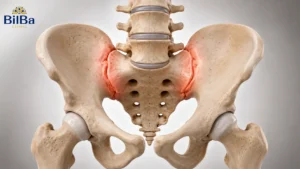
What Causes Sacroiliac Dysfunction
Sacroiliac dysfunction causes fall into a few broad groups. Sacroiliac joint dysfunction causes can be mechanical, meaning the muscles and ligaments supporting the joint aren’t controlling it properly, or non-mechanical, meaning something like causes of sacroiliac joint injury such as osteoarthritis, infection or inflammatory arthritis is affecting the joint directly. Si joint dysfunction causes and sacroiliac joint pain causes overlap heavily with these two groups, and in practice, several sacroiliac issues often combine rather than acting alone.
Sacroiliac Pain in Pregnancy
Sacroiliac pain pregnancy is one of the best known causes, and for good reason. The hormone relaxin loosens the ligaments around the pelvis to prepare for childbirth, but this also makes the sacroiliac joints less stable, which is why sacroiliac dysfunction in pregnancy is so common, particularly in the second and third trimesters.
Joint Ligament Laxity and Instability
Beyond pregnancy, sacroiliac ligament damage from a fall, car accident, or repetitive strain from heavy lifting or sport can leave the joint too loose, known as si joint hypermobility. The opposite problem, si joint hypomobility, happens when the joint becomes too stiff to move properly, often following prolonged poor posture or muscle imbalance. Both directions cause pain, just through different mechanisms.
What Is Hypermobile Joint Syndrome
This is the cause most people haven’t heard of. What is hypermobile joint syndrome? It’s a condition, closely related to Ehlers-Danlos syndrome, where joints throughout the body move beyond their normal range because the connective tissue holding them together is looser than usual. Hypermobility and sacroiliac joint pain are closely linked, since the sacroiliac joints are especially vulnerable to this kind of instability, and hypermobile patients can develop joint changes on imaging that look similar to inflammatory arthritis, even without any inflammation actually being present. If you’ve had unexplained sacroiliac pain for years without a clear trigger, and you’ve always been unusually flexible or double-jointed, this is worth raising with a clinician.
Less Obvious Causes Worth Ruling Out
A few other causes are well documented but rarely discussed:
- leg length discrepancy sacroiliac pain, since even a small difference in leg length shifts extra load onto one joint, and measuring leg length is recommended whenever sacroiliac dysfunction is suspected
- lumbar spinal fusion surgery, which removes movement at the fused level and pushes that motion onto the sacroiliac joint instead, one study found joint degeneration in 75 percent of fusion patients compared with 38 percent of those who hadn’t had surgery
- scoliosis, which changes how weight is distributed through the pelvis on each side
- running or other repetitive impact activity, particularly alongside a training change or uneven surfaces
- long periods of sitting, especially with poor posture or a job that involves sitting asymmetrically
None of these will apply to everyone, but if your sacroiliac pain doesn’t fit the usual pregnancy or injury story, one of these is often the missing piece.
Is It Really a Sacroiliac Muscle Strain
Sacroiliac muscle strain is a phrase a lot of people search, but it’s not quite accurate. The sacroiliac joint is a joint, not a muscle, so what’s usually happening is either dysfunction in the joint itself, or a strain in one of the surrounding muscles, such as the glutes or lower back muscles, that refers pain into the same area. The distinction matters because the treatment for a genuine muscle strain, rest and gentle stretching, is quite different from what helps joint-related dysfunction, which usually needs the joint’s stability addressed directly rather than just time off.
Sacroiliitis versus Sacroiliac Dysfunction
These two terms get used interchangeably, but they’re not the same thing. Sacroiliitis means the joint is actually inflamed, visible on a scan, and usually caused by arthritis, an autoimmune condition, infection or trauma. Sacroiliac dysfunction is about abnormal movement in the joint, hypermobility or hypomobility, and often shows nothing at all on imaging. Left untreated, ongoing dysfunction can eventually lead to inflammation and develop into sacroiliitis, but the two aren’t interchangeable diagnoses.
How Is Sacroiliac Dysfunction Diagnosed
How is sacroiliac dysfunction diagnosed often surprises people, since it isn’t primarily based on scans. A sacroiliac examination usually involves a set of physical tests, including the FABER test, where your hip is flexed, abducted and rotated outward, and the Gaenslen test, where pressure is applied through a bent leg while the other hangs off the edge of the table. When three or more of these tests come back positive, they correctly identify sacroiliac joint pain around 91 percent of the time.
A sacroiliac mri can still be useful, but mainly to rule out sacroiliitis or other causes rather than to confirm dysfunction itself, since dysfunction often doesn’t show up on a scan the way inflammation does. This is part of why the condition gets missed, a normal MRI doesn’t necessarily mean the joint is fine.

Living with Sacroiliac Dysfunction Day to Day
Day to day, dysfunction sacroiliac joint symptoms tend to flare with specific positions rather than constantly. Sleeping with sacroiliac joint pain is a common complaint, since rolling over or lying on the affected side can be uncomfortable. A pillow between the knees when lying on your side, and avoiding twisting movements when getting out of bed, can ease this for some people, though it won’t resolve the underlying sacroiliac issues on its own.
Who to See About Sacroiliac Dysfunction
Who to see for sacroiliac joint pain depends on how long you’ve had it and how it’s affecting you. Many people start with their GP, particularly to rule out other causes of lower back or hip pain first. A physiotherapist is usually a sensible next step for milder or more recent symptoms, since exercises to rebalance the muscles supporting the joint help a lot of people. For pain that’s persisted despite physiotherapy, or where the joint itself seems to be the problem rather than the surrounding muscles, a si joint specialist london clinicians can refer you to for an image guided injection may be more appropriate.

Sacroiliac Dysfunction Treatment at Bilba Clinic
If you think sacroiliac dysfunction might be behind your pain, Bilba Clinic offers both routes under one roof. Our physiotherapy team can assess and treat milder cases, while our Regenerative Medicine service includes ultrasound guided sacroiliac joint injections for cases that need more than exercise alone. Pricing for sacroiliac dysfunction treatment london starts from £850 for a single-sided injection, with full details on our pricing page.
Every appointment starts with a proper assessment, including the physical tests described above, rather than jumping straight to imaging or injections. If you’ve had a positive experience with joint injections before, our knee injection relief article covers a similar approach used for knee pain.
We’re based in Fitzrovia, central London, and as a CQC-registered clinic, our clinical team follows the same safety standards across every procedure, minor or major. When you’re ready, you can book online or get in touch if you’d like to ask questions first.
- Address: 57 Great Titchfield Street, Fitzrovia, London W1W 7PN
- Phone: +44 (0) 7858 848 244
- Email: info@bilbaclinic.co.uk
- Opening hours: Monday to Friday 10:00 to 18:00, Saturday 12:00 to 17:00, Sunday closed
Frequently Asked Questions
How Do You Know If You Have Sacroiliac Dysfunction?
The clearest signal is pain that’s worse on one side, sits low over the buttock or hip, and flares with standing, stairs or rolling over in bed. It’s not something you can fully confirm yourself though, since the symptoms overlap with several other causes of lower back and hip pain, which is why a proper examination matters.
How Is Sacroiliac Dysfunction Diagnosed?
Mainly through a set of physical tests rather than a scan, since three or more positive provocative tests are a strong indicator on their own. Imaging is used more to rule out other causes, such as sacroiliitis, than to confirm the dysfunction itself.
Can Sacroiliac Dysfunction Be Fixed?
Many people see real improvement with the right combination of physiotherapy, activity changes and, where needed, an injection, but whether it can be fully resolved depends on what’s actually driving it in your case, rather than there being one fix that works the same way for everyone.
What Is the Fastest Way to Fix Sacroiliac Dysfunction?
There isn’t a single fastest fix, and any treatment promising one is worth being cautious about. For most people, targeted physiotherapy combined with addressing the underlying cause, whether that’s pregnancy-related laxity, a leg length difference or something else, brings the most reliable improvement, sometimes alongside an injection if the joint itself needs calming down first.
Does Sacroiliac Dysfunction Get Worse Over Time?
It can, particularly if the underlying cause isn’t addressed and the joint keeps compensating in the same way. Left untreated for long enough, ongoing dysfunction can eventually contribute to sacroiliitis. It doesn’t always progress though, and plenty of people manage it well long term with the right support.