
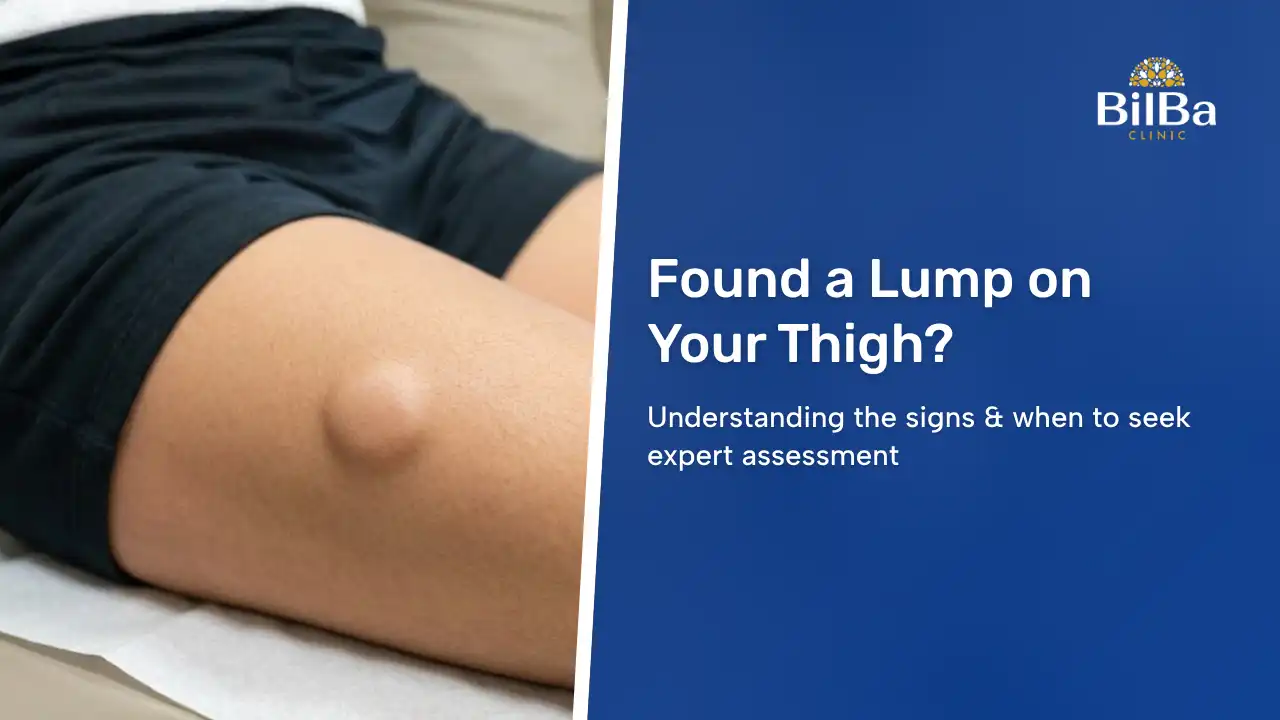
Finding a new lump under skin on thigh can be an unsettling experience. Whether you noticed it while showering or felt a slight pressure while sitting down, your mind likely jumped to several conclusions. However, most soft tissue growths on the leg we see are non-cancerous and can be managed effectively once we identify the cause for you. At our Fitzrovia clinic, we believe that understanding the nature of these lumps is the first step toward removing the anxiety surrounding them.
As a CQC-registered private clinic, we operate to the highest UK standards of clinical safety and patient care. You can also see us directly without a GP referral, making it simple to take the first step toward peace of mind on your own terms.
What Is a Thigh Lump Exactly
A thigh lump is technically any abnormal area of swelling or a growth that occurs anywhere between your hip and your knee. In most clinical cases we treat, these are “subcutaneous,” meaning they sit just beneath the surface of your skin and are not attached to the underlying bone. While they can vary in size from a small pea to a large marble, they are typically composed of either trapped fluid, overgrown skin cells, or a cluster of harmless fat cells.
How to Tell if Your Lump under skin on thigh Is a Cyst or a Fat Deposit
Distinguishing between a skin cyst and a fat deposit medically known as a lipoma, is the most common challenge we help our patients solve. A lipoma is a slow-growing cluster of fat cells that usually feels soft, doughy, and moves easily under the pressure of your finger. In contrast, we often find that a cyst is firmer to the touch and may have a tiny dark spot at its centre, known as a punctum, which is a small skin opening characteristic of an epidermal cyst.
While both are generally harmless, their “feel” is the biggest clue. A leg lump under skin that feels rubbery and slides around is likely a lipoma, whereas a lump that feels like a small, hard pill anchored just under the surface is more characteristic of a cyst. We recommend a professional palpation as the only way to confirm this for you without guesswork.
In cases where a physical examination alone is not conclusive, we can arrange imaging such as an ultrasound to give a clearer picture of the growth before recommending treatment.
Common Causes for an Inner Thigh Lump female
We often see women who discover an inner thigh lump female that can be particularly sensitive due to the friction of walking. These are frequently caused by blocked hair follicles or sweat glands. Because the skin in this area is thinner and more prone to moisture, it is also a common site for small epidermal cysts or even swollen lymph nodes if you have a minor infection elsewhere in the leg.
It is also worth noting that your hormonal fluctuations or physical activity can sometimes make these areas feel more prominent. While these lumps often resolve on their own if they are related to simple skin irritation, we suggest you let us review any persistent growth to rule out more complex skin conditions.
Why You Might Experience Thigh Lump Pain
Usually, a lipoma or a small cyst is entirely painless. However, you may experience thigh lump pain if the growth has reached a size where it begins to press against a sensory nerve. Pain can also occur if a cyst becomes inflamed, leading to redness and a stinging sensation. If your lump is located near a joint, the constant pressure of movement can cause a dull ache.
We can help you understand the type of pain you are feeling whether it is a sharp throb or a dull pressure and determine the best path forward for your comfort.
Recognising the Difference Between a Skin Growth and a Leg Muscle Lump
Occasionally, we see patients with a leg muscle lump that behaves differently than a skin growth. If your lump only becomes visible when you flex your thigh or stand up, it may be a muscle hernia, where a small amount of muscle tissue pokes through the surrounding fascia. These are distinct because they are deeper and directly tied to your muscular movements rather than the skin layer itself. Most muscle-related lumps we assess are functional and rarely require the same surgical approach as a cyst or a lipoma.
Understanding a Lump Thigh Near Groin or the Outer Leg
The location of your growth often changes how we diagnose it. A lump thigh near groin or a lump between thigh and groin can sometimes be a hernia or a swollen lymph gland. Meanwhile, an outer thigh lump is more frequently a lipoma or a “dermatofibroma” a small, hard, harmless bump that forms after a minor injury like an insect bite.
We carefully check localised lumps in these areas to ensure they aren’t interfering with the complex network of blood vessels near your hip.
Clinical Red Flags and When to Seek Medical Advice
While the majority of these growths are benign, we want you to be aware of certain “red flags” that should prompt a visit to us. You should seek our professional opinion if your lump feels very hard and fixed in place, grows rapidly over a few weeks, or if the skin over the lump becomes dimpled.
- The lump is larger than 5cm in diameter
- It feels “stuck” to the underlying tissue or bone
- There is persistent, unexplained pain or heat
- You notice new lumps appearing simultaneously
If you notice any of these changes, we can assess this quickly to give you the clarity you need. Any tissue we remove can also be sent to our pathology laboratory for analysis, giving you complete clarity on what was growing beneath your skin.
If you have multiple lumps or accompanying symptoms such as fatigue or unexplained weight loss, we may recommend one of our Health Screening Packages to investigate further.
Your Options for Lipoma on Thigh Removal
If your growth is causing discomfort or affecting your confidence, lipoma on thigh removal is a straightforward procedure we perform regularly. We prioritise a discreet and unhurried approach to minor surgery. The process involves a small incision under local anaesthetic, allowing us to remove the growth entirely to ensure it does not return.
- Surgical Excision: The most effective way we ensure a lump does not grow back.
- Aspiration: A needle is used to draw fatty tissue from a lipoma. This may reduce the size, but the lipoma can return if not fully removed.
- Observation: If your lump is small and painless, we may simply advise you to monitor it.
We always prefer professional removal over “home remedies,” as we want to protect you from the high risk of scarring and permanent infection. Minor skin surgery at Bilba Clinic starts from £250 for a consultation, with treatment pricing discussed clearly and transparently before any procedure begins.
Clinical Assessment and Treatment at Bilba Clinic
We understand that living with a mystery lump can be a source of daily anxiety. At Bilba Clinic, we help you understand what this means for your health through a clear, professional diagnosis. Our goal is to replace your worry with a concrete plan, whether that involves simple reassurance or expert treatment.
Your journey with us typically begins with a Private GP consultation, where we assess your lump, review your medical history, and determine the right course of action — all without the wait of the NHS.
We can assess this quickly in our private Fitzrovia rooms, providing you with a calm environment to discuss your concerns. You can book an appointment with us directly, without the need for a GP referral, allowing you to take the next step toward health and comfort on your own terms.
If you are ready to move forward, we invite you to explore our minor skin surgery options or view our clinical team to see how we provide the high-quality care you deserve. We guide you on the next steps from the moment you walk through our doors, ensuring you feel understood and supported.
Frequently Asked Questions About Leg Lumps
What does a lump on your upper thigh mean?
Most often, we find that a growth in this area is a benign soft tissue mass. It could be a lipoma, a sebaceous cyst, or occasionally a swollen lymph node. Because your upper thigh contains muscles, tendons, and lymph vessels, the meaning depends on whether the lump is hard, soft, or movable. We can provide a definitive answer during a physical examination.
Why do i have a lump on my thigh?
Lumps develop for several reasons, ranging from simple skin irritation to internal growths. Common causes we treat include a lump under skin top of thigh caused by an ingrown hair, a persistent fat deposit, or even a small hernia. We can help you identify if a previous injury has caused “fat necrosis,” where damaged tissue forms a firm, harmless bump.
What causes lipomas under the skin?
The exact cause is not fully understood, though we often see it run in families. They occur when fat cells overgrow in a specific area between your skin and muscle. They are not caused by your diet, and we generally find them to be harmless unless they grow large enough to become uncomfortable for you.
Could a lump on my thigh be cancer?
While the vast majority of lumps we see are benign, a small percentage can be more serious, such as a sarcoma. We look for red flags like a lump that is hard, fixed, larger than 5cm, or growing rapidly. If you notice these, we recommend you visit us for an immediate specialist assessment to give you peace of mind.
What should I do if I find a lump inner thigh near groin female?
In women, we frequently find a lump inner thigh near groin female is related to skin friction or blocked glands. However, because this area is close to important nerves and vessels, we advise you let us check it to rule out a femoral hernia or a more complex cyst that may require our professional attention.
Is it possible to remove a lump for cosmetic reasons?
Absolutely. Many of our patients choose removal simply because they dislike how a lump looks or feels under their clothes. We perform these excisions with a focus on minimal scarring and your overall aesthetic result.
How do I know if my lump is infected?
If you notice the area becoming hot, red, or increasingly painful, it may be infected. We can assess this for you and provide the necessary treatment or drainage to prevent the infection from spreading.