
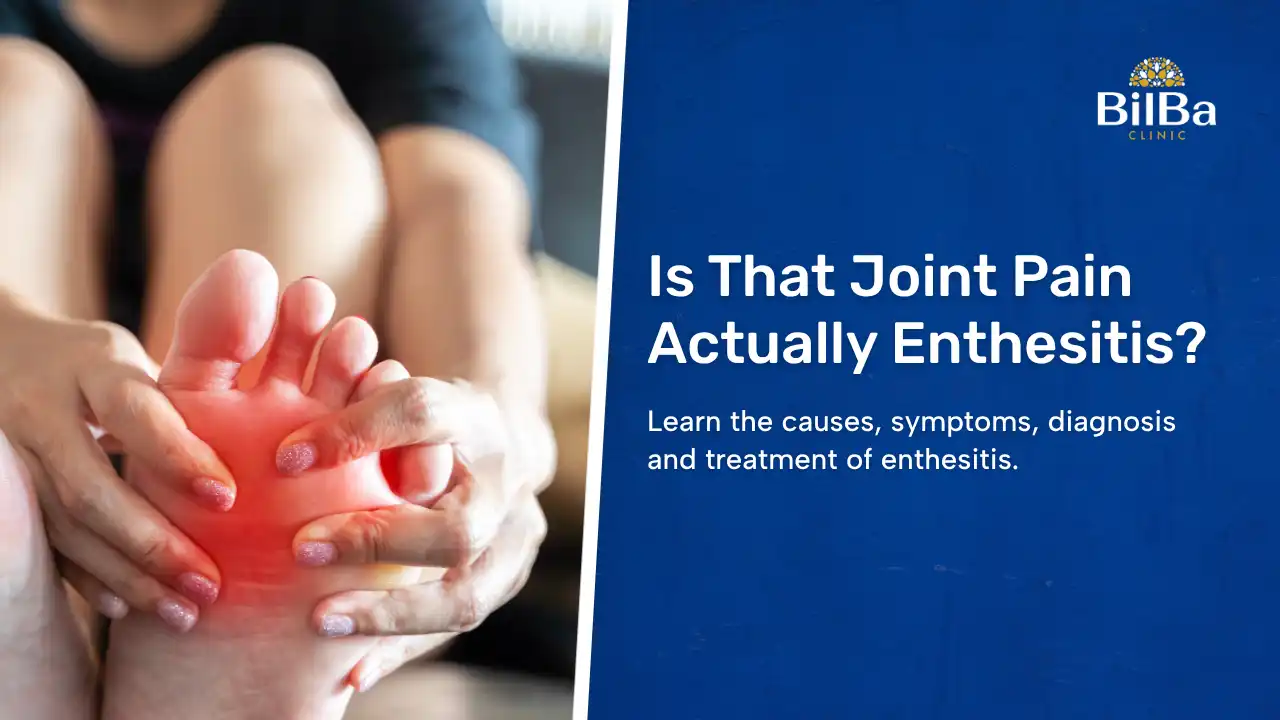
That ache near your joint that won’t fully go away, does it ever feel like it’s not quite inside the joint itself, more like it’s tugging right where a tendon meets the bone. That’s often enthesitis, and it’s a lot more common than most people realise. In this guide we’ll explain what enthesitis actually means, why it so often gets confused with arthritis, what causes it, where it tends to show up, and how we assess and treat it here at Bilba Clinic.
What Enthesitis Actually Means, and Why It Isn’t Joint Pain
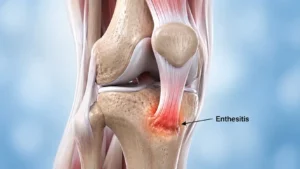
Enthesitis meaning, in plain terms, is inflammation or pain at an enthesis, the specific point where a tendon or ligament attaches to bone. Some clinicians simply describe it as tendon insertion pain, which is a more everyday way of putting the same thing. It sits right next to a joint, which is exactly why it gets mistaken for joint pain so often, but it isn’t the same mechanism at all. Joint pain usually comes from inside the joint capsule itself, arthritis being the classic example, while enthesitis happens at the attachment point just outside it.
Why It Gets Mistaken for Arthritis
Because the enthesis sits so close to the joint, the pain can feel identical to arthritis from the outside, especially around the heel, elbow, or hip. Enthesitis vs arthritis really comes down to location and cause, arthritis affects the joint surface itself, while enthesitis affects the tendon or ligament attachment beside it. Getting this distinction right matters, because the two are managed quite differently and mixing them up can delay the right treatment.
How It’s Different from Ordinary Tendonitis
Enthesitis tendonitis confusion is common too. Tendonitis usually means inflammation along the length of a tendon, whereas enthesitis is specifically at the point where that tendon inserts into bone. In practice, the difference in enthesitis vs tendinitis often comes down to exactly where the pain is most tender, right at the bone, or further along the tendon itself. Both can coexist, which is part of why an accurate assessment matters more than guessing from symptoms alone.
Enthesopathy, the Broader Condition Enthesitis Sits Under
What is enthesopathy. It’s the umbrella term for any disorder affecting an enthesis, whether that’s inflammation, degeneration, or calcification at the attachment point. Enthesitis specifically refers to the inflammatory type, which is the most common form we see, but enthesopathy as a category also covers longer term wear changes that build up gradually rather than flaring suddenly. In some literature this overlaps with what’s called insertional tendinopathy, though the terms aren’t always used consistently between sources, which adds to the general confusion patients run into when researching their own symptoms.
What Actually Causes Enthesitis to Develop
Enthesitis causes fall into two broad categories, autoimmune and mechanical, and figuring out which applies to you shapes how we approach treatment.
The Autoimmune Link, Psoriatic Arthritis and Ankylosing Spondylitis
Enthesitis psoriatic arthritis and enthesitis ankylosing spondylitis are well recognised associations. Ankylosing spondylitis enthesitis and psoriatic arthritis enthesitis are the two forms referenced most often in medical literature, and both belong to a family of conditions called spondyloarthritis, where the immune system drives inflammation at entheses throughout the body rather than just in one spot. Is enthesitis an autoimmune condition on its own.
Not exactly, it’s better understood as a feature that shows up within certain autoimmune conditions, rather than being a separate autoimmune disease itself. If you already have a diagnosis of psoriatic arthritis or ankylosing spondylitis, enthesitis is a well recognised feature of both. That said, having enthesitis doesn’t automatically mean you have either condition, plenty of cases are purely mechanical and never involve the immune system at all.
Overuse and Mechanical Strain
Repetitive movement, sudden increases in activity, or ongoing strain on a tendon attachment can all lead to tendon attachment inflammation without any autoimmune involvement whatsoever. This is the kind of overuse injury we see often in runners, people who’ve recently ramped up training, or anyone doing repetitive manual work that keeps pulling on the same ligament to bone attachment day after day. A patient asking what causes enthesopathy of hip pain specifically is often dealing with strain at the gluteal or hip flexor attachment points, usually from a change in training load or a new activity the body hasn’t adapted to yet.
Where Enthesitis Commonly Shows Up
Enthesitis can develop almost anywhere a tendon or ligament meets bone, which is why it turns up in so many different places:
- Enthesitis hands and enthesitis fingers, often where the finger flexor tendons attach
- Enthesitis in feet, particularly at the plantar fascia attachment under the heel
- Enthesitis hip, at the points where hip muscles anchor onto the pelvis
- Enthesitis elbow, similar in feel to tennis elbow but specifically at the tendon insertion
- Enthesitis ankle, enthesitis shoulder, and enthesitis wrist, all less common but still seen regularly
Heel pain, elbow pain, and hip pain are the presentations we hear about most often in consultations, usually described as a deep, localised ache rather than a general soreness.
Achilles Enthesitis, the Most Common Presentation
Achilles enthesitis, sometimes searched as enthesitis achilles, is one of the most frequent forms we treat. It develops where the Achilles tendon attaches to the heel bone, and it often causes stiffness first thing in the morning or after rest, easing slightly with gentle movement before tightening up again with activity or at the end of the day. Enthesitis in the heel or Achilles area responds well to focused assessment, since the exact location of tenderness, right at the bone versus further up the tendon, tells us a lot about what’s actually happening and how best to approach it.
Is Enthesitis Something to Worry About
It’s rarely an emergency, but it’s not something to just push through indefinitely either. Patients often ask us does enthesitis cause damage if it’s left alone, and the honest answer is that ongoing, untreated inflammation at an enthesis can contribute to stiffness and reduced movement in the surrounding area over time, even though it’s very unlikely to be dangerous in itself. If a specific spot near a joint has been tender and unresolved for more than a few weeks, particularly if it’s affecting your normal activity, it’s worth having it properly assessed rather than assuming it’ll settle on its own.

How We Diagnose Enthesitis at Bilba Clinic
Diagnosis starts with a proper conversation, where exactly the pain is, when it started, whether it’s linked to activity, and whether you have any personal or family history of psoriatic arthritis or ankylosing spondylitis. From there, our clinicians assess the affected area directly, checking exactly where the tenderness sits and how the joint and surrounding tendons move together. Where useful, we can also arrange soft tissue and tendon ultrasound to confirm exactly what’s happening at the attachment point rather than relying on symptoms alone, which gives a much clearer picture before deciding on treatment.
How We Treat Enthesitis, Including Achilles-Specific Options
How to treat enthesitis depends heavily on where it is and what’s driving it, but the approach at Bilba Clinic generally starts the same way regardless of location, confirming the diagnosis, then choosing the most appropriate option for your specific case. Enthesitis achilles tendon treatment and enthesitis achilles treatment elsewhere on the body both follow this same logic. Best treatment for enthesitis pain generally combines activity modification with a targeted injection where the inflammation is more stubborn, rather than relying on rest alone, which often isn’t enough on its own to resolve a well established case.
What a Trigger Point Injection Actually Involves
Trigger point injection for enthesitis is one of our core treatments for this condition, delivered directly to the affected attachment point to calm the local inflammation and ease pain. For Achilles specific cases, we also offer ESWT, shockwave therapy, as a complementary, non-injection option that can be used alongside or instead of an injection depending on your case. How to treat achilles enthesitis specifically often depends on how long you’ve had symptoms and how well it’s responded to simpler measures first, such as activity changes or supportive footwear.
Recovery timing varies depending on how long you’ve had symptoms and which enthesis is involved, but most patients notice some easing within a couple of weeks of a trigger point injection, with fuller improvement building over the following month or so as the inflammation settles. We usually suggest modifying activity around the treated area rather than complete rest, since gentle movement supports healing at a tendon attachment better than staying still. A follow-up appointment lets us check progress and decide whether a second injection, or a different approach such as ESWT, would help further.
Do You Need an Autoimmune Diagnosis to Get Treated
No, and this is worth being clear about. Enthesitis without psoriatic arthritis is very common, plenty of patients we see have mechanical enthesitis with no autoimmune link at all. You don’t need a rheumatology referral or an existing diagnosis to book in, we assess and treat purely mechanical cases just as often as ones linked to a known autoimmune condition.
What Enthesitis Treatment Costs at Bilba Clinic
Enthesitis treatment cost UK wide varies a lot depending on the clinic and the type of injection used, so here’s what ours looks like. An initial sports medicine consultation starts at £300, and trigger point injection for enthesitis is priced from £500 for a single injection, or £700 where more than one area needs treating. These figures are a starting point rather than a fixed quote, for the most current pricing it’s worth checking our pricing page directly before booking.
Book Your Enthesitis Assessment With Us
If you’ve been living with pain near a joint that hasn’t settled, it’s worth getting it properly assessed rather than guessing at what it is. Looking for enthesitis treatment London wide, or specifically a sports medicine clinic London based and easy to reach. You can book a consultation online with our sports medicine team, or get in touch first if you’d rather ask a few questions before committing to an appointment. We’re one of the clinics offering trigger point injection London patients can book directly, without a referral, and as a private enthesitis clinic Fitzrovia is easy to reach from across the city. If you’re curious about other image guided injection treatments we offer, our knee injection guide covers a similar approach for a different joint.
Your Enthesitis Questions Answered
What causes enthesitis?
Most cases come down to either mechanical overuse at a tendon attachment or an autoimmune link to conditions like psoriatic arthritis or ankylosing spondylitis. Both are common, and figuring out which applies to you shapes the right treatment.
Is enthesitis the same as arthritis?
No. Arthritis affects the joint surface itself, while enthesitis affects the tendon or ligament attachment point beside the joint, they’re closely related in location but different in mechanism, and that difference changes how each is treated.
How is enthesitis diagnosed, and does enthesitis show up on an X-ray or scan?
Diagnosis usually starts with a clinical assessment of exactly where the pain is. Ultrasound imaging can often confirm inflammation at the attachment point directly, giving a clearer picture than symptoms alone, though a standard X-ray doesn’t always pick up the earliest changes.
Is enthesitis serious, does it cause lasting damage?
It’s rarely an emergency, but ongoing, untreated inflammation can affect movement and comfort over time, so it’s worth having persistent cases assessed rather than left indefinitely.
Can enthesitis be cured? Can enthesopathy be cured more broadly?
Many cases respond well to treatment and settle a great deal, though we can’t promise every case resolves completely, particularly where there’s an underlying autoimmune driver that needs ongoing management alongside local treatment.