
If you have typed sciatica how to diagnose into a search bar, you are probably not sure whether your leg pain is nerve pain at all. The honest answer is simpler than most people expect. Most sciatica is diagnosed from your story and a hands-on examination, not a scan. A clinician listens to where the pain travels, checks your reflexes, strength and sensation, and rules out anything that needs urgent care. Scans have a place, but they are rarely the first step. Here is how the process works and what each test tells you.
Short answer: sciatica is diagnosed from your history and a physical examination, including checks of your reflexes, strength, sensation and the straight leg raise test. A scan is added only if its result would change your care.
A quick way to tell what you may be dealing with:
- Sharp, burning or tingling pain that runs from the buttock down the back of one leg, sometimes into the foot: fits sciatica
- Aching that stays in the lower back, with nothing travelling into the leg: more likely ordinary back pain
- A deep ache in the buttock or around the pelvis that changes with sitting or standing on one side: may be a muscle or joint problem near the nerve
Which Sciatica Symptoms of the Leg and Foot Point to the Nerve?
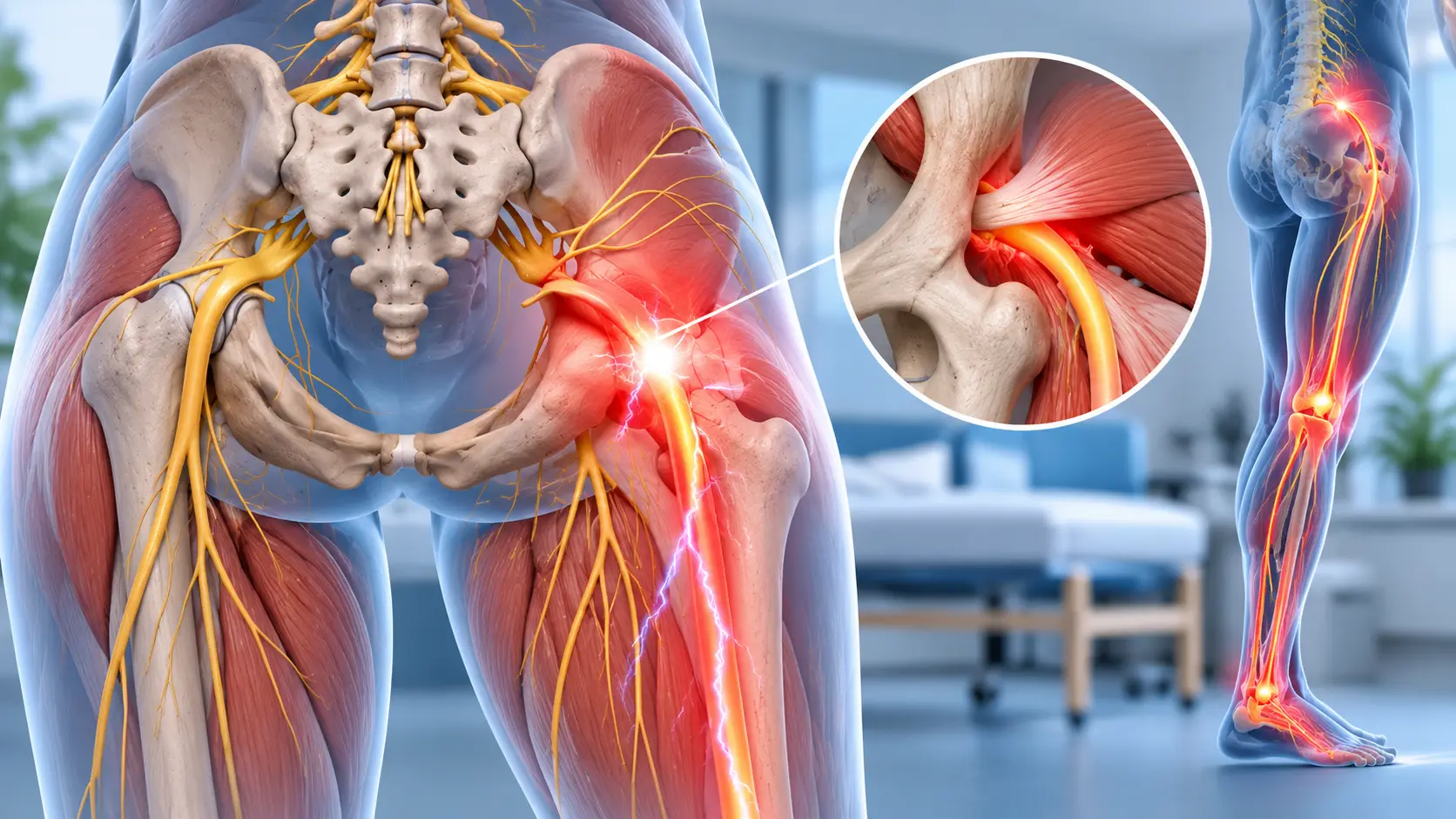
The sciatica symptoms of the leg and foot that point to the nerve are pain, tingling, numbness or weakness in the bottom and the back of one leg, often reaching the foot and toes. Back pain may be there too, but it is usually milder than the leg pain. Pain that gets worse when you move, sneeze or cough also fits.
Direction matters more than severity. A clinician wants to know whether the pain starts in the back and travels, or stays put. They also ask whether it feels burning, sharp or like pins and needles, because a dull ache in one spot suggests something different. The NHS says you probably do not have sciatica if you only have back pain, which is why this first sorting step carries so much weight. If you would like to know what irritates the nerve in the first place, our guide to the causes of sciatica covers that, so here we stay with how the problem is confirmed.
Are Sciatica Symptoms in Women Any Different?
Sciatica symptoms in women are the same as in men: pain, tingling, numbness or weakness running down one leg. The nerve behaves the same way whoever it belongs to. What differs is the context a clinician has to consider, such as your cycle, a recent pregnancy or pelvic conditions that can cause lower back and pelvic pain.
That is why a good history includes questions that may seem unrelated to your leg. Does the pain change at certain points in the month? Has anything changed in your periods, or do you have pelvic pain at other times? None of this means something is wrong. It helps the clinician decide whether the nerve in the back is the likely source or whether another cause needs a closer look.
Sciatica Pain During Period, Nerve or Cramps?
Sciatica pain during period is most often period cramps spreading, not a trapped nerve. The NHS says period cramps can spread to the back and thighs, which can feel very like sciatica. A true nerve cause is uncommon, but if leg pain follows your cycle month after month, a doctor should look into it.
Doctors have described rare cases where endometriosis, a condition where tissue similar to the womb lining grows elsewhere, irritates the sciatic nerve and causes leg pain that rises and falls with the cycle. The NHS lists pain in the lower tummy and back among the symptoms of endometriosis and advises seeing a GP if you think you might have it. A simple diary helps: note the dates, where the pain travels and how long it lasts. Bring it to your appointment. If your period pain is severe or worse than usual and painkillers have not helped, the NHS advises asking for an urgent GP appointment or contacting 111.
How Is Sciatica Detected at a First Appointment?
How is sciatica detected? A clinician starts with your history, then examines your back and legs. They check where the pain travels, test your reflexes, muscle strength and sensation, and look for anything that needs urgent care. The NHS says a slipped disc, the most common cause of sciatica, can usually be diagnosed from your symptoms.
Knowing how to diagnose sciatica problems properly starts with the right questions. When did the pain begin, and was there a trigger such as lifting or a long drive? Is it one leg or both? Does coughing make it worse? Have you noticed any change in your bladder or bowel control, or numbness around your bottom or genitals? Have you had it before? Each answer narrows the possibilities, and some of them decide whether you need urgent care today.
Our clinical team works through these steps in this order, because the conversation usually tells us more than any single test. The physical examination follows. We watch how you stand, walk and bend, then test reflexes at the knee and ankle, strength in the foot and leg, and sensation along the leg. The NHS describes this as raising your arms or doing simple leg exercises to find out where the problem is. Together, these findings point to which nerve root in the lower back is being irritated, and that guides the next step.

What Happens in the Straight Leg Raise Test?
In the straight leg raise test, you lie on your back while a clinician lifts your straightened leg. If the lift brings on your usual leg pain, the test is positive, which suggests the nerve is irritated. It takes seconds, needs no equipment and is one of several checks, not a verdict on its own.
Lifting the straight leg gently stretches the sciatic nerve, and a nerve that is already irritated reacts with its familiar pain. We explain each movement as we go, because the test should only reproduce the pain you already know. You can read more about our clinic and the clinicians who carry out these assessments before you book.
What Does the Straight Leg Raise Test For and What Does It Miss?
A common question is what does straight leg raise test for. It tests for irritation of a nerve root in the lower back, most often from a disc pressing on it, by checking whether the nerve reacts to being stretched.
What it misses matters just as much. Tight hamstrings, the muscles at the back of the thigh, can cause a pulling pain that looks like a positive result when the nerve is fine, so a clinician checks where the pain is felt and what it feels like. A crossed version, where lifting the unaffected leg brings on pain in the sore leg, is less often positive but more convincing when it is.
Straight Leg Raise Test Interpretation, What a Positive Result Means
Straight leg raise test interpretation depends on the whole picture. A positive result raises the suspicion of nerve irritation, and a negative result does not rule it out. Neither answer stands alone.
One Cochrane review of physical tests for a disc pressing on a nerve found that the straight leg raise picked up most people who had the problem but also gave a positive result to many people who did not, in studies mostly made up of people heading for surgery. The crossed version showed the reverse pattern. The review concluded that most single tests perform poorly on their own, and that combining findings works better. That is why we never base a diagnosis on one movement. We weigh the test alongside your history, reflexes, strength and sensation before drawing a conclusion.
If you would rather have these checks done than guess, you can book online for an assessment at our Fitzrovia clinic.
Is There a Diagnosis of Sciatica Test Beyond the Examination?
There is no single diagnosis of sciatica test that settles the question. Doctors combine your history, the examination and, only when needed, imaging. NICE guidance advises against routinely offering imaging in non-specialist settings for low back pain with or without sciatica, and says imaging in specialist settings should be considered only if the result is likely to change management.
A scan is useful when it will change what happens next, not as a way of confirming what the examination already shows. Many people expect an MRI on day one and feel surprised when we do not arrange one, but a picture does not treat the pain, and the first weeks of care are usually the same either way. Our sports medicine consultations are built around this approach, with a careful examination first and a clear reason for any test we suggest.
When Is an MRI Actually Needed for Sciatica?
An MRI is needed when its result will change what happens next. That can mean pain that has not improved with treatment, weakness or numbness that is getting worse, or planning an injection or surgery. The NHS says that if symptoms do not get better, you may be referred for tests such as an MRI.
If your pain is severe and treatments have not helped, the NHS says you may be referred to a hospital specialist to discuss options such as an injection or surgery, and that is the kind of moment when imaging earns its place. Emergency symptoms are different. They need urgent hospital assessment, not a booked scan. If we think a scan would help, we explain why and what we expect it to show, and we refer you for it. If we do not, we say so.
Sciatica vs Cauda Equina, How Do You Tell the Difference?
Sciatica usually affects one leg and is painful. Cauda equina syndrome is a rare emergency in which the nerves at the base of the spine are compressed, and it tends to bring symptoms on both sides or changes in the bladder, bowel or genital area. The NHS says to call 999 or go to A&E if you notice these signs.
We ask about this at every assessment, because telling the two apart is one of the most important jobs of the examination. A quick way to separate them:
- One leg, with pain, tingling, numbness or some weakness: typical sciatica, and a reason to see a GP if it is not improving after a few weeks
- Both legs affected, or weakness and numbness in both legs that is severe or getting worse: an emergency
- Numbness around or under your genitals, or around your bottom: an emergency
- New difficulty controlling your bladder or bowels, when this is not normal for you: an emergency
If any emergency sign applies, do not drive yourself. The NHS advises asking someone to take you or calling 999 for an ambulance, and bringing your medicines with you. Most people with leg pain will never have cauda equina syndrome, so one sore leg is not a reason to panic. Our guide to the urgent warning signs lists the full set from the NHS.
What Else Can Feel Like Sciatica?
Several problems copy sciatica, including a tight piriformis muscle in the buttock, a sore sacroiliac joint at the base of the spine and hip problems. Pain that stays in the buttock or back, or changes with certain positions, points away from the nerve.
The piriformis muscle sits deep in the buttock, and when it tightens it can press on the sciatic nerve and cause leg pain without any problem in the spine. Our article on a piriformis injury explains how that looks in practice. The sacroiliac joint, where the spine meets the pelvis, can produce pain that spreads into the buttock and thigh, and our guide to sacroiliac joint pain covers how to spot the difference. The distinction matters because the treatment differs, so a clear diagnosis saves weeks of treating the wrong thing.
What Should You Expect Once Sciatica Is Confirmed?
How long sciatic pain last varies between people. The NHS says sciatica usually gets better within a few weeks to a few months but can last longer. If it has not improved after a few weeks of home care, or it is getting worse or stopping you doing normal things, the NHS advises seeing a GP.
Another common worry is, will sciatica come back? It can. The NHS says there is a chance it returns if you have had it before, and lists ways to lower that chance: staying active, using safe lifting technique, keeping good posture when you sit and stand, losing weight if you are overweight, and not smoking. The NHS also advises carrying on with normal activities as far as you can and starting gentle exercise as soon as you are able, since long spells of sitting or lying down tend to slow recovery. Physiotherapy is a usual part of that plan. It is free on the NHS, though waiting times can be long, and you can also have it privately.

Book a Sciatica Assessment at Bilba Clinic in Fitzrovia
Bilba Clinic is a CQC-registered private clinic in Fitzrovia, London, offering medical, aesthetic and wellbeing care from experienced clinicians. We are recognised by major insurers including Bupa, Vitality and WPA, and we also see self-pay patients who prefer to book directly.
If you are unsure whether your leg pain is sciatica, an appointment gives you a clear answer without unnecessary tests. We take your history, examine your back and legs, explain what we find and say whether a scan would help. Same day appointments are often available.
Costs vary with what you need, so we would rather give you an accurate figure after a proper look. As a general guide, an initial consultation with our sports medicine team starts at £300, a private GP initial consultation is £120, and physiotherapy is £80 for 30 minutes or £120 for 60 minutes. Our pricing page has the current figures.
To book:
- Address: 57 Great Titchfield Street, Fitzrovia, London W1W 7PN
- Phone: +44 (0) 7858 848 244
- Email: info@bilbaclinic.co.uk
- Opening hours: Monday to Friday 10:00 to 18:00, Saturday 12:00 to 17:00, Sunday closed
You can also book online or get in touch with any questions before your visit.
Frequently Asked Questions
Do I Need an MRI to Diagnose Sciatica?
No, not usually. Most sciatica is diagnosed from your history and an examination, and NICE advises against routine imaging in non-specialist settings. An MRI is considered when its result would change your care, for example if symptoms are not improving, weakness is getting worse, or an injection or surgery is being planned.
Who Should I See First for Suspected Sciatica?
Start with a GP, or refer yourself to your local NHS musculoskeletal service, which in many areas you can do without a GP referral. If you prefer to be seen privately, a private GP or physiotherapist can assess you. Go straight to A&E, or call 999, if you have any of the emergency signs described above.
Can an X-ray Show Sciatica?
Not directly. An X-ray is a picture of bone, while sciatica is irritation of a nerve, so a normal X-ray does not rule it out and an abnormal one does not prove it is the cause of your pain. The diagnosis still rests mainly on your symptoms and the examination.
Can You Test for Sciatica at Home?
Not reliably. You can notice whether the pain travels below the knee, whether coughing or sneezing makes it worse, and whether you have tingling or numbness, and that information helps a clinician. Lifting your own leg at home is not a dependable test, because tight hamstrings can produce the same pull. If symptoms have not improved after a few weeks, see a GP.