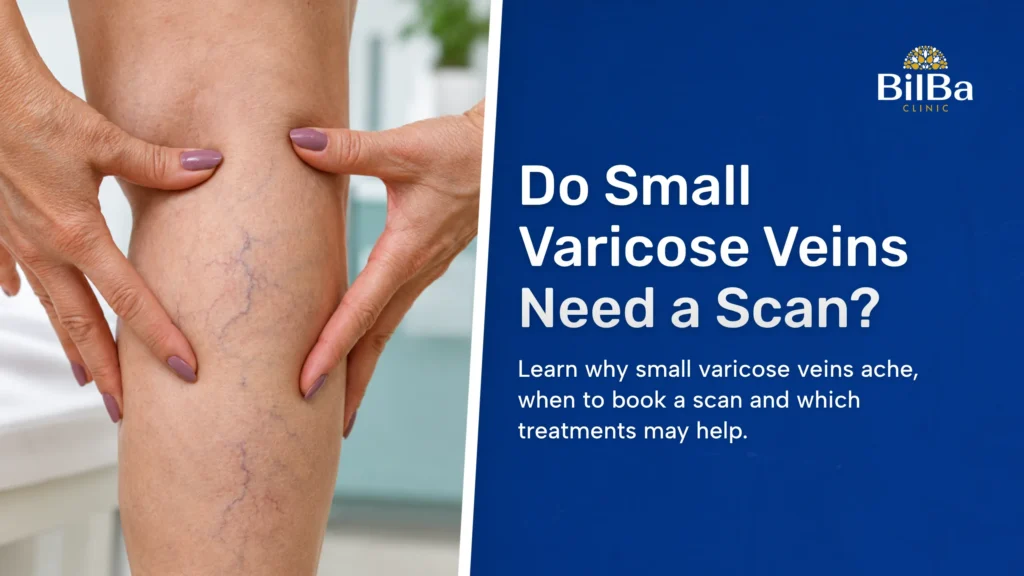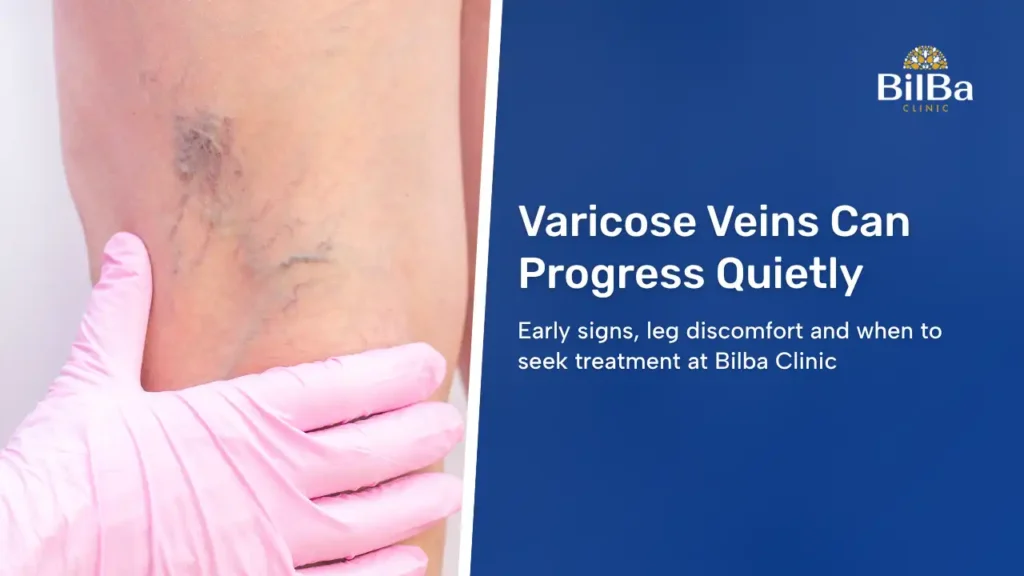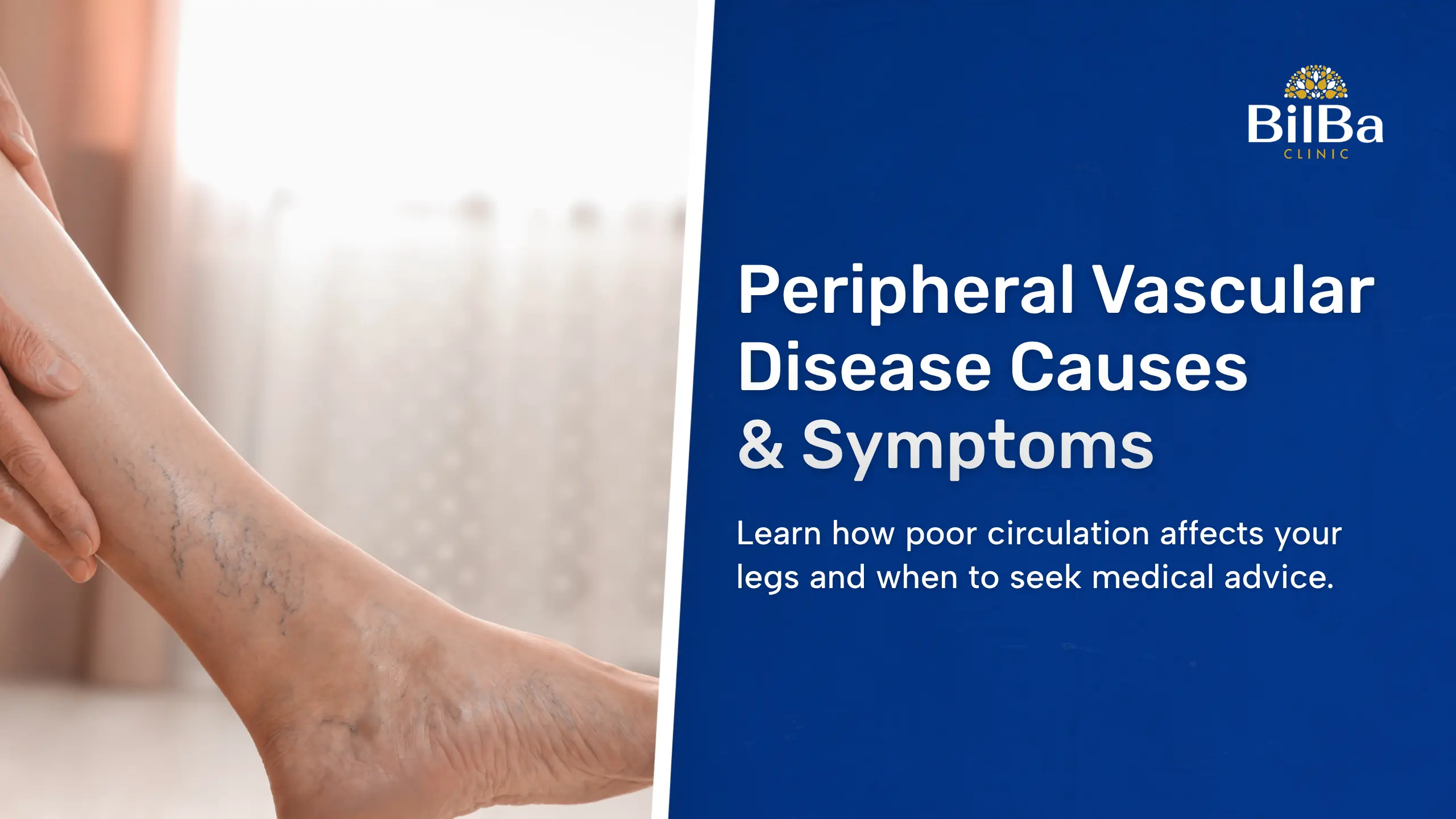
Peripheral vascular disease is a condition where the blood vessels carrying blood to your legs become narrowed, so your leg muscles do not get the blood flow they need. It is also called peripheral arterial disease. It builds slowly, and many people notice nothing at first. Then calf pain on walking appears and settles with rest. It is more likely if you smoke, have diabetes or are getting older. Slow-healing sores on the legs or feet, and skin that looks paler, bluer or shinier with hair loss, are two other signs worth knowing. A medical check settles whether your symptoms point to it. At Bilba Clinic, we assess leg circulation and explain what the findings mean for you.
What Is Peripheral Vascular Disease Symptoms Like, and When Do They Appear?
Many people with peripheral vascular disease have no symptoms in the early stages. When symptoms do appear, the most common is leg pain on walking that eases with rest. Other signs include hair loss on the legs and feet, brittle toenails, numbness or weakness, and sores that do not heal. They tend to build over months or years.
Because the changes come on gradually, many people put them down to age or tiredness. The walk to the shops that used to be easy now needs a stop halfway. Toenails grow slowly and break easily, or the hair on the shins thins. None of this feels urgent alone, which is why the condition is often picked up late. Leg pain from poor circulation is not a normal part of ageing, and it deserves a check.
Skin changes are easy to miss. The skin may turn paler or take on a bluish tone, or look shiny and tight. These colour changes are harder to see on brown and black skin, so feel and temperature matter as much as colour. The leg muscles can also look thinner, and some men notice erectile difficulty alongside the leg symptoms. A sore on the leg or foot that will not heal is one of the clearest signs that needs attention. If you recognise two or more of these together, book a check. Anyone weighing up a visit can find more about Bilba Clinic and how we work before deciding.
How Does Peripheral Vascular Disease in Legs Differ From Other Leg Problems?
Peripheral vascular disease in legs usually shows up as pain, sores or skin changes linked to walking and reduced blood flow, rather than swelling alone. Swollen ankles, heavy legs and visible twisted veins more often point to a vein problem. The two can overlap, so a proper assessment matters.
Vein problems such as varicose veins tend to bring aching, heaviness, itching, swelling and skin colour changes, and sometimes slow-healing sores. Narrowed arteries bring pain that follows a pattern: it appears after a certain amount of walking and fades within minutes of stopping. A useful clue is timing. Swelling that builds through the day and eases overnight points one way. Pain that arrives after a set distance and fades with rest points another.
Puffy ankles are often a separate issue, and swollen ankles have several common causes worth reading about. A vascular assessment looks at your circulation as a whole, so you do not need to work out which problem you have before you book.
Why Peripheral Vascular Disease Leg Pain Often Shows Up When Walking
Peripheral vascular disease leg pain often appears when you walk because your leg muscles need more blood during activity than narrowed arteries can deliver. The pain, felt mainly in the calf, eases after a few minutes of rest. It can affect one leg or both, and it can feel mild or severe.
Think of it as a supply problem. At rest, your muscles need little, so a narrowed vessel copes. Once you start walking, demand rises, supply falls short, and the muscle protests. Rest lets demand drop and the pain fades. Set off again and it returns at roughly the same distance.
Pain that comes back at the same distance each time deserves a check. Muscle strain, joint trouble and nerve problems can also cause leg pain, and telling them apart is what an examination is for.
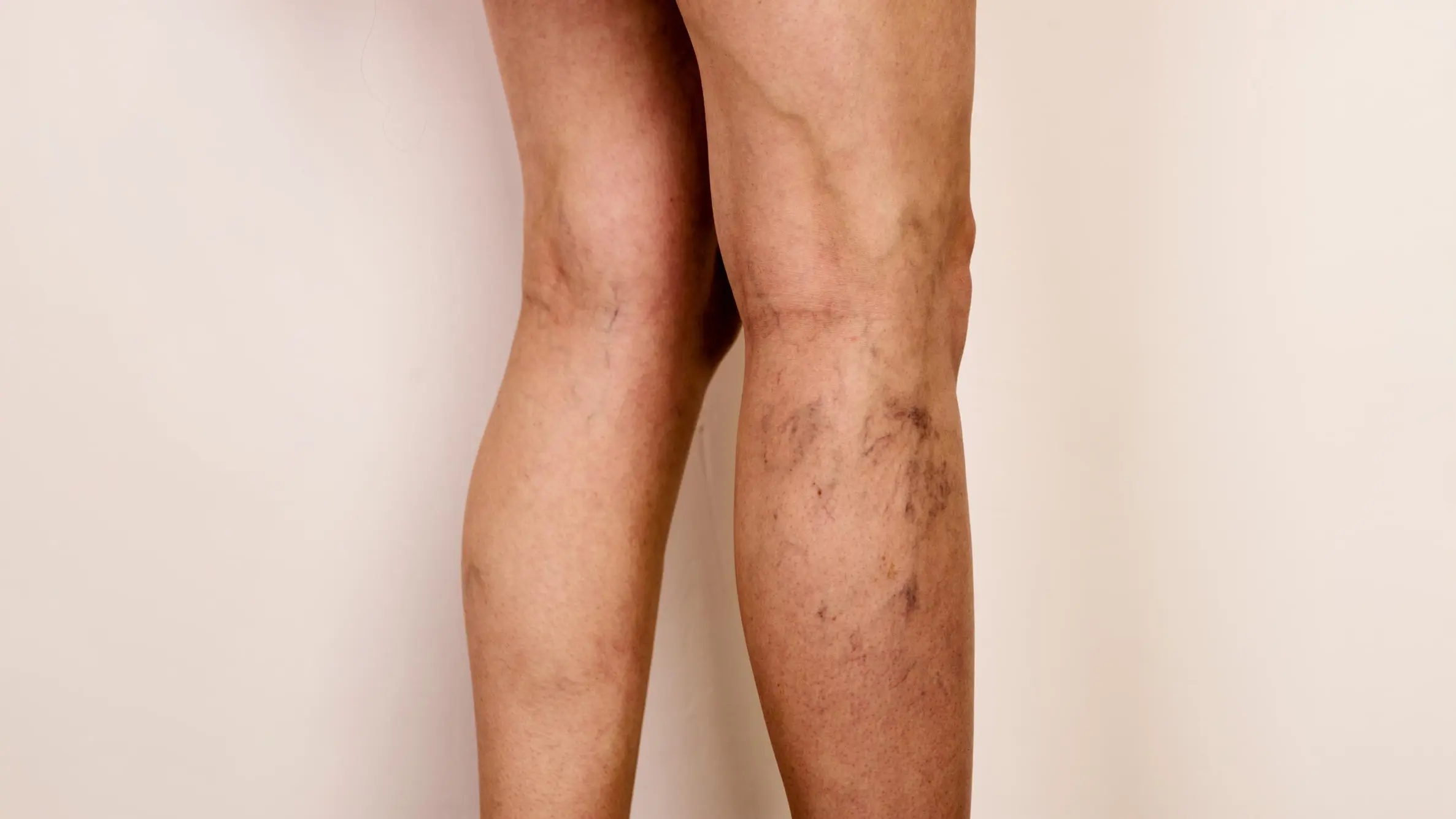
Peripheral Vascular Disease Causes Explained, From Fatty Deposits to Daily Habits
Peripheral vascular disease causes usually come down to fatty deposits building up inside the arteries of your legs. The deposits are made of cholesterol and other waste substances. They narrow the arteries and restrict the blood reaching your leg muscles. It is a form of cardiovascular disease, so it can reflect the health of your blood vessels more widely, as NHS information also explains.
The build-up is slow and silent. Over years, the lining of an artery can become coated, leaving less room for blood to pass. Narrowing in one part of the body can be a sign that others are under strain too. That is one reason we treat leg circulation as part of your overall health, not a leg problem alone.
Everyday habits and existing conditions feed the process. Smoking, diabetes, high blood pressure and high cholesterol all add to it.
What Causes Peripheral Vascular Disease to Get Worse Over Time?
What causes peripheral vascular disease to get worse is mostly what started it: continued smoking, untreated high blood pressure, high cholesterol and poorly controlled diabetes. Each keeps damaging the arteries, so the narrowing can continue. Acting on these factors early gives you the best chance of keeping symptoms stable.
Because symptoms build slowly, the condition can be present for some time before you feel anything. If any of these apply to you, it is worth having your circulation checked before symptoms appear.
Peripheral Vascular Disease Risk Factors and Who Is More Likely to Get It
Peripheral vascular disease risk factors include smoking, diabetes, high blood pressure, high cholesterol and getting older. Smoking is one of the strongest. If you have one or more of these and your legs hurt when you walk, have your legs checked.
- Smoking, now or in the past.
- Type 1 or type 2 diabetes.
- High blood pressure or high cholesterol.
- Increasing age.
Age on its own is not a diagnosis. Plenty of older adults have healthy circulation, and the condition can affect younger people who carry other risk factors. What matters is the combination, along with how your legs behave when you move. Before your visit, jot down which of these apply and bring any recent results for blood pressure, cholesterol or diabetes.
Diabetes with Peripheral Vascular Disease, Why Feet Need Extra Care
Diabetes with peripheral vascular disease needs extra care because diabetes can damage the blood vessels in the legs and dull feeling in the feet. A small sore may go unnoticed, then heal slowly because less blood reaches the area. Any foot sore, infection or circulation concern should be assessed early.
If you live with diabetes, look at your feet every day, including between the toes and under the heel. Tell us about any sore that is slow to heal, any colour change, and any numbness or tingling you cannot explain. Numbness or tingling in the feet often links to diabetic foot pain, which has its own causes.
What a Peripheral Vascular Disease Diagnosis Involves
A peripheral vascular disease diagnosis starts with an examination of your legs and a conversation about your symptoms and medical history. We look at your skin, nails, hair, any sores and the pulses in your feet. In most cases, the examination and a simple blood pressure comparison at the ankle and arm are enough to confirm it. A scan is added where more detail is needed.
During the examination, we look for:
- Shiny skin, brittle toenails, and hair loss on the legs and feet.
- Leg or foot sores that are slow to heal.
- Pulses in the feet that feel weak or cannot be found.
We also ask about smoking, diabetes, blood pressure and cholesterol, because they shape how we read what we find. It helps if you can tell us when the pain starts, how far you can walk before you stop, and how long it takes to ease. A few photos of any skin change or sore, taken over several days, can show how things are moving.
Our clinical team explains each step as it happens, so you know what is being checked and why. Not everyone needs every test, and we will say plainly if further checks are worth doing.
Which Peripheral Vascular Disease Test Will You Be Offered?
The peripheral vascular disease test you are offered depends on your symptoms and what the examination shows. The usual first test compares blood pressure at the ankle with the arm. A lower reading at the ankle suggests less blood is reaching the leg. A scan using sound waves follows if we need to see where flow is reduced. More detailed imaging is kept for selected cases.
If you have diabetes, ankle readings can be less reliable, so a normal result does not always rule the condition out. In that case, we rely more on your symptoms, the examination and the scan.
We explain what each test measures before it is done, and what the result means afterwards. You will not be left holding a number without knowing what it says about your legs.
How Doppler Ultrasound Peripheral Vascular Disease Scans Work
A Doppler ultrasound peripheral vascular disease scan uses sound waves to show how blood moves through the vessels in your legs. It is non-invasive and highlights where blood flow is reduced. The same scan can look at your leg veins, which helps separate vein problems from narrowed arteries.
A probe sends sound waves into the leg and picks up how they bounce back from moving blood. The result becomes a picture and a measurement of flow. We then talk you through the results and explain the next step for your situation.
What Treatment for Peripheral Vascular Disease Looks Like in Practice
Treatment for peripheral vascular disease depends on how far the narrowing has gone. For most people it includes:
- Stopping smoking.
- Regular walking or supervised exercise.
- Controlling blood pressure, cholesterol and diabetes.
- Medicines to lower the risk of clots, heart problems and stroke.
A smaller number of people need a procedure to open or bypass a narrowed artery.
Walking is treatment, not just advice. Regular walking or supervised exercise can lengthen the distance you cover before pain starts. With treatment, symptoms stay stable for most people, and some feel an improvement. The condition does not usually clear completely, so the aim is to ease symptoms and protect your heart and circulation.
Your examination findings decide which of these steps fit you. We explain the options in plain language, and you are never pushed into a decision on the day.

Book a Vascular Assessment at Bilba Clinic
Bilba Clinic is a CQC-registered private clinic in Fitzrovia, London, offering medical, aesthetic and wellbeing care from experienced clinicians. We are recognised by major insurers, including Bupa, Vitality and WPA, and we also welcome self-pay patients.
If you are unsure whether your symptoms are worth a visit, that uncertainty is itself a good reason to come, because an assessment gives you an answer either way. You can book an assessment online or contact us first with a question.
Costs vary depending on what is needed, and we would rather give you an accurate figure after an examination. As a starting guide, a vascular consultation starts from £250 and a Doppler scan from £350, and our pricing page shows current figures. If a leg suddenly becomes painful, pale, cold, numb or changes colour, seek emergency medical help straight away.
- Address: Bilba Clinic, 57 Great Titchfield Street, Fitzrovia, London W1W 7PN
- Phone: +44 (0) 7858 848 244
- Email: info@bilbaclinic.co.uk
- Opening hours: Monday to Friday 10:00 to 18:00, Saturday 12:00 to 17:00, Sunday closed
Frequently Asked Questions About Peripheral Vascular Disease
Is Peripheral Vascular Disease Serious?
Peripheral vascular disease can be serious because it signals that your blood vessels are unhealthy, and it raises the chance of heart problems and stroke. Early on, symptoms can be mild. Left alone, reduced blood flow can lead to sores that do not heal. An assessment shows how advanced it is and what to do next.
Does Peripheral Vascular Disease Affect One Leg or Both?
Peripheral vascular disease often affects both legs, although the pain can be worse in one. It can range from mild to severe, and signs in one leg are sometimes easier to spot than in the other. If a leg suddenly becomes painful, pale, cold or numb, seek emergency medical help straight away.
Can Peripheral Vascular Disease Go Away on Its Own?
Peripheral vascular disease does not usually go away on its own. It is a long-term condition that is managed rather than cured. Stopping smoking, regular exercise, medicines, and controlling blood pressure, cholesterol and diabetes can ease symptoms and keep them stable. Your examination results show where you stand.
When Should You Get Leg Pain Checked?
Book an assessment soon if leg pain returns every time you walk the same distance, if a sore will not heal, or if the skin on your leg or foot changes colour. If a leg suddenly becomes severely painful, pale, cold or numb, seek emergency medical help straight away.
What Happens at a Peripheral Vascular Disease Assessment at Bilba Clinic?
At Bilba Clinic, we examine your legs, ask about your symptoms and health, and compare ankle and arm blood pressure. We arrange a Doppler scan if more detail is needed. We then explain the findings and the next step in plain language, so you leave knowing what is happening and what your options are.