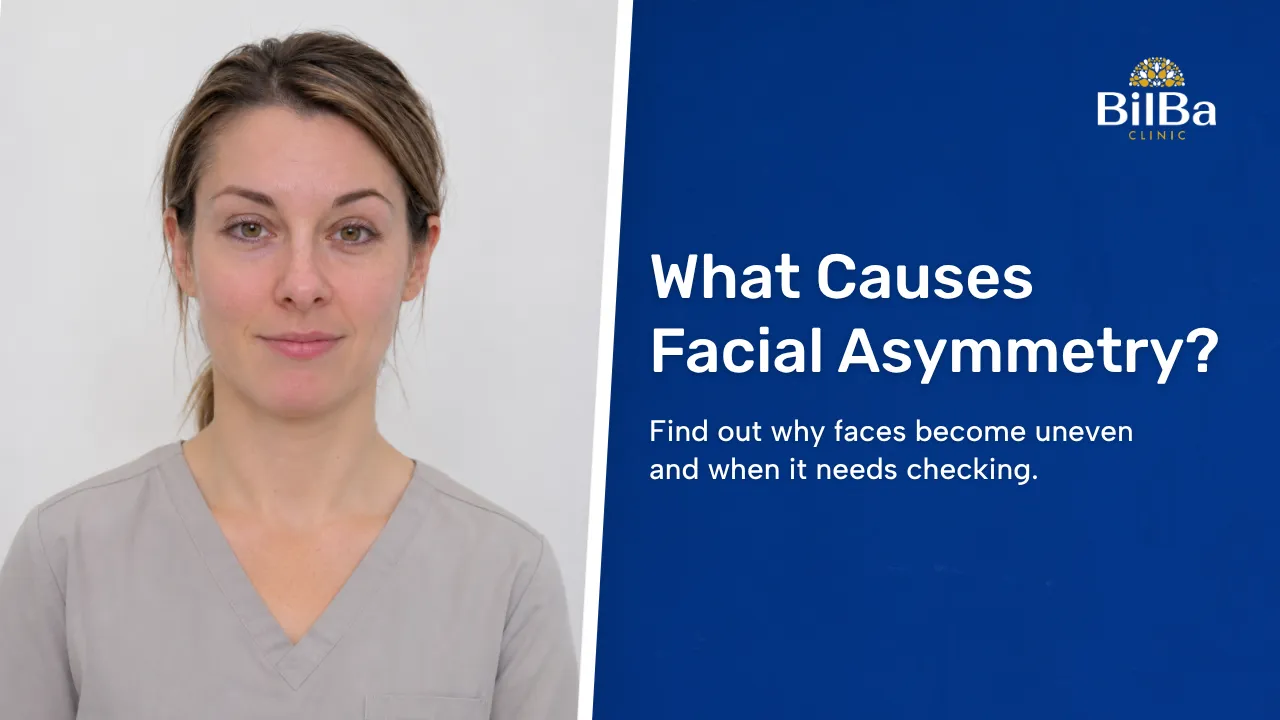
Almost nobody has a perfectly even face, and facial asymmetry in a mild form is very common. Most of the time it reflects how your face developed, and it has always been there. Less often, a difference between the two sides is a sign of something that needs a proper look, particularly if it appears quickly. At Bilba Clinic we see both kinds, and the first thing we ask is not how uneven the face looks, but how long it has looked that way and whether it is changing. This guide explains the causes, what counts as normal, how an assessment works and which changes cannot wait.
What Causes Asymmetrical Face Shape, From Birth to Later Life?
What causes asymmetrical face shape depends largely on when the difference began. Some people are born with it, or it develops as the face grows. Others notice it after an injury, dental treatment or an illness that affects the facial nerve. The next two sections take each group in turn, starting with what is there from the early years.
Causes of Face Asymmetry Present From Birth and Early Growth
The causes of face asymmetry present from birth sit in how the face formed and grew. A perfectly symmetrical face is rare, and stress during development can affect the two sides differently. Some people are also born with a facial nerve problem, known as congenital facial palsy, which leaves one side moving less than the other.
A difference that has been there since early life leaves a trail. If the same difference shows in pictures from ten or twenty years ago, it points to a long-standing pattern and not something new. That history is one of the first things we ask about, because a difference that has always been there is handled very differently from one that has just appeared.
How Injury, Dental Treatment and Illness Can Change Your Face
Injury, dental treatment and illness can all change the balance of your face in adulthood. These facial asymmetry reasons vary a great deal, and some are temporary while others last, so the history matters as much as the way the face looks today. None of them is a failing on your part.
Injury is the simplest example. A fall that breaks the nose can leave the face looking different, and injuries to the face or the base of the skull can also damage the facial nerve, which controls the muscles that move the eyebrow, eyelid, cheek and mouth.
Dental treatment can play a part as well. Local anaesthetic given for dental work is one recognised cause of facial nerve weakness, and so is surgery near the ear.
Illness is the group that matters most to catch. Bell’s palsy is the most common acquired cause of facial nerve weakness, and it is linked to infection or a reduced blood supply to the nerve. A stroke or a tumour can also be behind a change, which is why a new difference is always worth checking properly. More than one of these can apply at once, so we ask about your history before drawing conclusions.
Is Facial Asymmetry Normal, or Is Yours Worth Checking?
Is facial asymmetry normal? In its mild form, yes. A perfectly symmetrical face is rare, so some difference between the two sides is the norm. It becomes worth checking when it is new, getting more obvious, changing how your face moves, or bothering you enough that you want to know why.
The line between normal and worth checking is seldom about how uneven the face looks. It comes down to time and movement. A difference that has stayed the same for years sits in a different category from one that appeared recently, or one that comes with weakness, numbness or pain.
Checking a difference is not the same as committing to treatment. For many people the most useful outcome is a clear explanation of what they are looking at and whether it is likely to change. You can ask the question without any plan to do anything about the answer.
When an Uneven Face Is Just Your Natural Shape
An uneven face that has looked the same for years is most likely just your natural shape. Small differences in brow height, the corners of the mouth, the line of the jaw or the position of the eyes are common, and on their own they rarely mean anything is wrong.
Even a smile is seldom perfectly level, and most people have a slightly lopsided mouth when they smile. Other signs that a difference is part of your natural pattern include being visible in old photographs, staying the same from year to year, and holding steady while you smile, frown and speak. Even then, you may simply want to understand it, and that is a perfectly good reason to ask. At our clinic we would rather tell you it is normal after a proper look than leave you wondering.
Bring a photo from a few years ago if you can. It helps us see whether anything has changed, and it can settle the question quickly. If something has changed, that is the point where a closer look becomes worthwhile, and the next sections explain what we would be looking for.
What Different Kinds of Facial Asymmetry Look Like
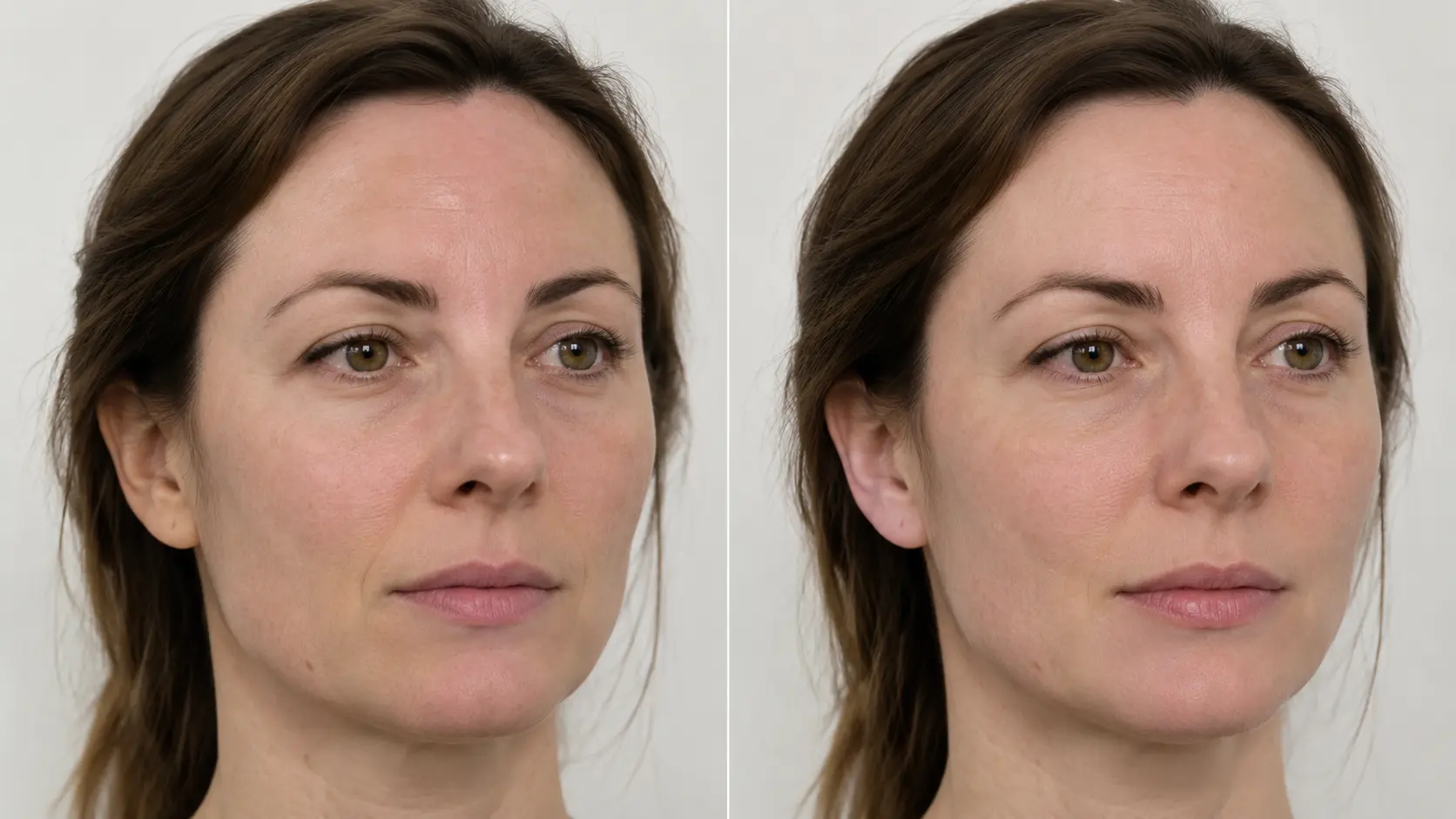
Facial asymmetry does not look the same in everyone, because the cause sits in different layers of the face. Some differences come from the bone beneath, some from the soft tissue on top of it, and some from how the muscles and nerves are working. Sorting yours into one group is the first step.
Facial Asymmetry Types, From Bone Shape to Soft Tissue
Facial asymmetry types fall into three broad groups: bone and jaw shape, soft tissue such as skin, fat and muscle, and nerve-related weakness. Many people have a mix. Working out which group applies matters, because it decides whether a difference is likely to stay the same, can be softened, or needs urgent medical attention.
- Bone and jaw shape: the framework of the face sits a little differently on each side, which can be present from birth or follow an old injury.
- Soft tissue: one cheek, chin or brow carries less volume, or the muscles on one side pull harder.
- Nerve and muscle weakness: one side moves less, which can show as a lower brow, a drooping corner of the mouth or an eye that does not close fully.
These groups can overlap, so someone with a different jaw shape can also have uneven volume in one cheek. Jaw position is handled differently from soft tissue. Jaw surgery exists to correct facial imbalance, including asymmetry, and it is usually considered when braces alone cannot fix the alignment. We will tell you plainly if that is what your face needs, because it sits outside what we offer.
A brow that sits lower on one side is one soft tissue pattern, and our guide to a direct brow lift explains one surgical option for a brow that has dropped. Nerve-related weakness is the group that most often needs a medical opinion before anything else, and the next section explains why.
Facial Asymmetry Symptoms, or Just a Normal Difference?
Facial asymmetry symptoms is a slightly misleading phrase, because uneven features are generally a sign, not a symptom. A long-standing difference with nothing else going on is normal. The picture changes when the unevenness comes with weakness, numbness, pain, a drooping eyelid or mouth corner, or trouble closing one eye.
A drooping eyelid on one side has a list of causes of its own, which we cover in our guide to droopy eyelid causes. Weakness that spreads across one side of the face over a few days is a different matter. One example is Bell’s palsy, a temporary weakness of the facial nerve. It can cause a drooping eyelid or mouth corner, difficulty closing one eye, a dry or watering eye, drooling and a change in taste.
Most people with Bell’s palsy improve over a few months, but a stroke can look similar, so the first step is a prompt medical assessment to rule out other causes. If a change like this has come on recently, ask us for an urgent review, or follow the emergency advice below if it was sudden.
Is There a Reliable Facial Asymmetry Test, and What Does an Assessment Involve?
There is no single reliable facial asymmetry test you can run at home. Photos and mirrors change with angle, lighting and expression, so they can exaggerate a difference or hide one. A proper assessment looks at your face at rest and in movement, and asks how long you have noticed the change.
At Bilba Clinic, that starts with a conversation. We ask when you first noticed the difference, whether it has changed, and whether there has been an injury, dental work or other treatment. We then look at your face at rest and while you move it, for example when you smile, raise your brows and close your eyes. Photographs from the past help us compare the two sides over time, so it helps to bring a few dated pictures, a note of any injury or dental work, and the date you first noticed the change. None of this needs to be perfect, and a rough timeline is enough.
From there, the outcome tends to fall into one of three groups. Your face may simply be naturally uneven, and you leave knowing that. The difference may sit in soft tissue and be something we can talk through softening. Or the pattern may suggest something that needs further medical assessment, and we will say so plainly. Our clinical team will explain what we find in plain words, and a plastic surgery consultation is the usual starting point for a facial concern like this.
What If One Side of Your Face Changes Suddenly?
If one side of your face changes suddenly, treat it as urgent. A face that droops, a smile that goes lopsided, or weakness or numbness on one side can be a sign of a stroke. Check the NHS stroke signs and seek emergency medical help straight away, even if the change seems to settle.
Speed matters more than certainty here. You do not need to be sure what is causing it, and you should not wait to see whether it passes.
Facial Asymmetry When Smiling, and the Signs That Cannot Wait
Facial asymmetry when smiling that has only just appeared is a warning sign. If one side of your mouth will not lift, or your smile looks lopsided for the first time, that needs urgent medical attention, especially alongside weakness in an arm or slurred speech.
These signs need emergency help straight away:
- Your face droops on one side, or your smile suddenly looks lopsided
- You cannot lift both arms and keep them raised
- Your speech is slurred or confused
- One side of your face or body feels weak or numb
Weakness on one side of the face can have causes other than a stroke, including Bell’s palsy and, less often, infections or injuries that affect the facial nerve. Treatment for some of these works best when it starts early, which is another reason not to wait.
Slower changes still matter. A difference that has crept on over weeks, comes with pain or a change in hearing on one side, or has not improved after about three weeks should have a proper assessment too. If that sounds like you, ask us for an urgent review and we will advise you on the next step.
Talk to Us About Facial Asymmetry Before Choosing Any Treatment
Bilba Clinic is a CQC-registered private clinic in Fitzrovia, London, offering medical, aesthetic and wellbeing care from experienced clinicians. We are recognised by major insurers, including Bupa, Vitality and WPA, and we welcome self-pay patients as well.
If your face has always been a little uneven, you may leave with nothing more than reassurance, and that is a good outcome. If you do want to talk about softening a difference, we would rather look properly first than suggest a treatment from a photo. Costs vary depending on what we find, so we prefer to give you an accurate figure after an assessment. A plastic surgery consultation is currently £250, and our pricing page is the best guide to current figures. You can read more about our plastic surgery service before you decide.
If your concern is new or has changed quickly, say so when you book so that we can advise on timing. If it has always been there, a routine appointment is a sensible way to start, and there is no need to hurry.
You can book online or reach us through our contact page.
- Address: 57 Great Titchfield Street, Fitzrovia, London W1W 7PN
- Phone: +44 (0) 7858 848 244
- Email: info@bilbaclinic.co.uk
- Opening hours: Monday to Friday: 10:00 to 18:00, Saturday 12:00 to 17:00, Sunday closed
Frequently Asked Questions About Facial Asymmetry
Is Facial Asymmetry Common?
Yes. A perfectly symmetrical face is rare, so mild facial asymmetry is very common and almost everyone has some difference between the two sides. It counts as normal variation, and a difference you have always had, with no change over time, usually needs no treatment, though you are welcome to have it looked at if it bothers you.
Is Facial Asymmetry Noticeable in Real Life?
It depends on the size of the difference and where it sits. Mild differences between the two sides are usually hard to spot in everyday conversation, while a clear difference in the brows, the corners of the mouth or the jaw line is easier to see. How noticeable it is to others matters less than how it feels to you.
Can You Fix Facial Asymmetry?
Sometimes it can be softened, but not always, and not permanently. Where the difference comes from soft tissue, such as less volume on one side of the face or one brow sitting higher than the other, dermal fillers or anti-wrinkle injections can sometimes improve the balance.
Anti-wrinkle injections can relax the muscle that lifts the higher brow, and fillers can add volume to the flatter side. Fillers are gradually broken down by the body, so the effect is not permanent, and we would discuss how long to expect it to last at your assessment. Differences rooted in bone or jaw position are a different question, and we will tell you plainly if something sits outside what we offer. That is why an assessment comes before any suggestion of treatment. A sudden change is never a cosmetic question and needs urgent medical attention first.