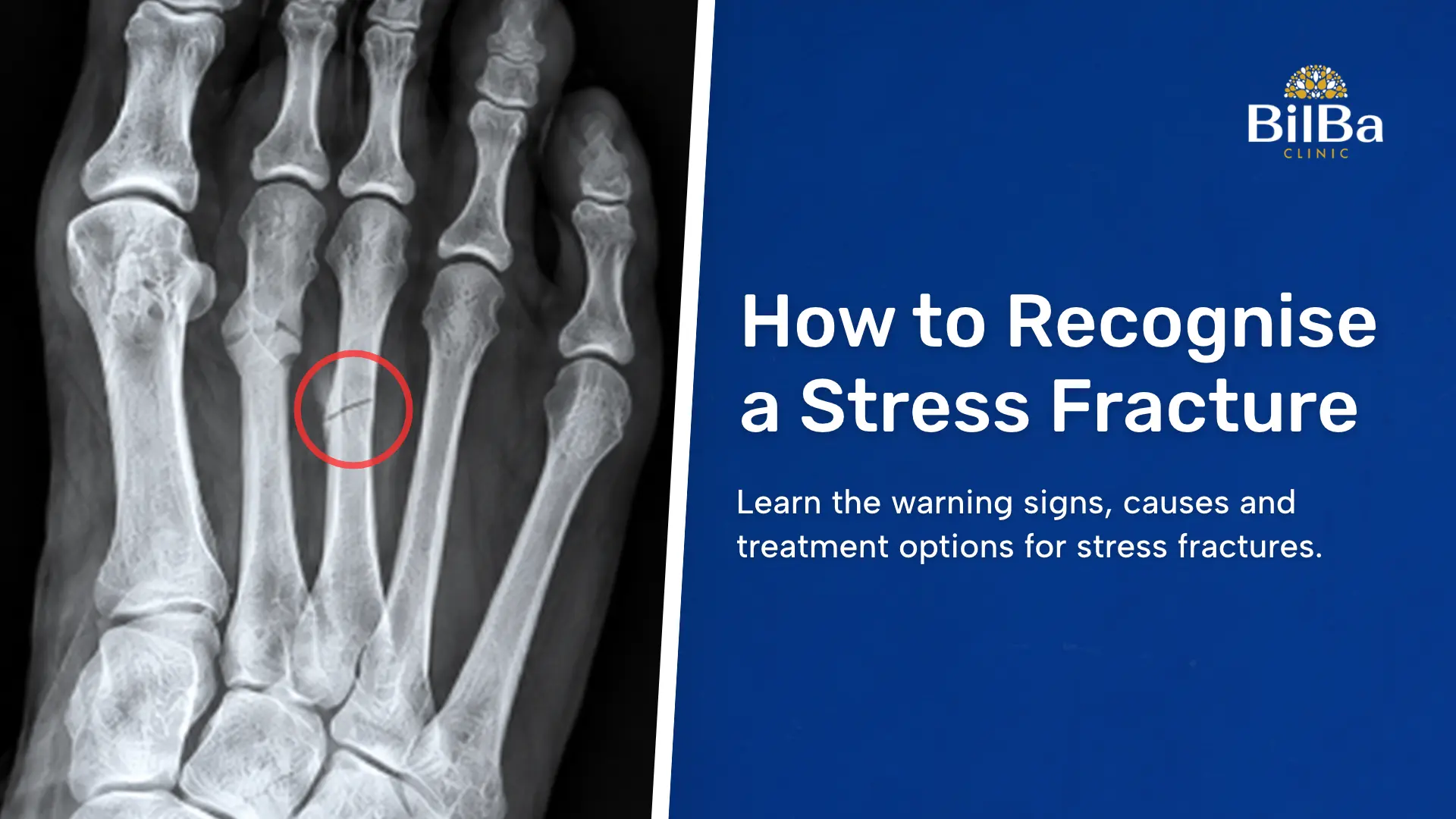
If your pain sits in one spot on a bone, builds as you keep moving and has no clear injury behind it, a stress fracture is a real possibility. A stress fracture is a small crack in a bone, caused by repeated load that the bone could not keep up with. It can look like a strain or ordinary soreness, and an early X-ray can look completely normal. That is why a proper examination matters more than waiting to see what happens. Same day appointments are often available at our Fitzrovia clinic, so you do not have to carry on guessing.
Short answer: a stress fracture is a small crack in a bone from repeated load. It typically causes a dull, tender pain in one spot that builds with activity and eases with rest, and an early X-ray can still look normal. Pain like that, especially if it keeps returning, is worth a proper examination.
Here is a quick way to tell the common possibilities apart:
- Pain over a small spot on a bone, tender to press and worse with load: could be a stress fracture
- Aching in the muscle that eases once you warm up and stretch: more likely a strain
- Pain along a broad stretch of the front of the shin after running: often shin splints
Stress Fracture Symptoms You Should Not Ignore
Stress fracture symptoms usually begin as a dull pain in one place on a bone. The pain grows with activity and eases with rest, the spot is tender when you press it, and swelling may appear. Over days or weeks, the pain tends to arrive earlier in each session.
That slow build is what makes a stress fracture easy to dismiss. There is often no fall, twist or moment you can point to, only a pain that keeps coming back a little sooner than last time. Our clinical team listens for exactly this pattern, because it separates a bone problem from a muscle one before any scan is booked. If the pain is also keeping you awake, is there when you are resting, or has started to make you limp, treat that as a reason to be seen sooner.
While you wait for an appointment, the sensible move is to stop the activity that sets it off. Gentle movement that does not provoke the pain is fine, and doctors advise against running on an injury that has not been diagnosed. Resting for a few days costs you very little, whereas training through a crack can cost you months.
What Does a Stress Fracture Feel Like When You Move?
What does a stress fracture feel like? Most people describe a dull, deep ache in one spot on a bone, rather than a sharp stab. It gets worse when you put weight through the area or repeat the movement that caused it, and eases when you stop.
Doctors describe a typical rhythm. The pain can be present at the start of a run or walk, ease off once you are warmed up, and then return afterwards. Because it eases during the activity, plenty of people keep going and push through it, which is one of the commonest ways a small crack grows. Pressing directly on the bone is usually tender. A strained muscle tends to be sore along its length, while a stress fracture is sore at a point.
How Do You Know If You Have a Stress Fracture or a Strain?
How do you know if you have a stress fracture? You cannot be certain from how it feels alone. A stress fracture is more likely when the pain is over the bone itself, is tender to a firm press, is linked to a recent rise in activity and does not settle with a few days of rest. A strain more often hurts over the muscle and settles faster.
Pain where a tendon attaches to the bone can add to the confusion, and our guide to tendon attachment pain explains how that looks. A clinician sorts these out by taking your history, pressing along the bone and watching how you load the limb. Our sports medicine team uses the examination first, and then decides whether imaging would change what happens next. Many people can be diagnosed from the story and examination, and a scan is added when it is needed.
In practice, a first appointment covers when the pain began, what your training or work looks like, any recent change in shoes or surfaces, and whether anything else about your health could be weakening the bone. Those answers often point to the cause as clearly as the examination does.
If you would rather know than guess, you can book online for a review at our Fitzrovia clinic, with same day appointments often available.
Stress Fracture Foot Pain and Where It Usually Starts
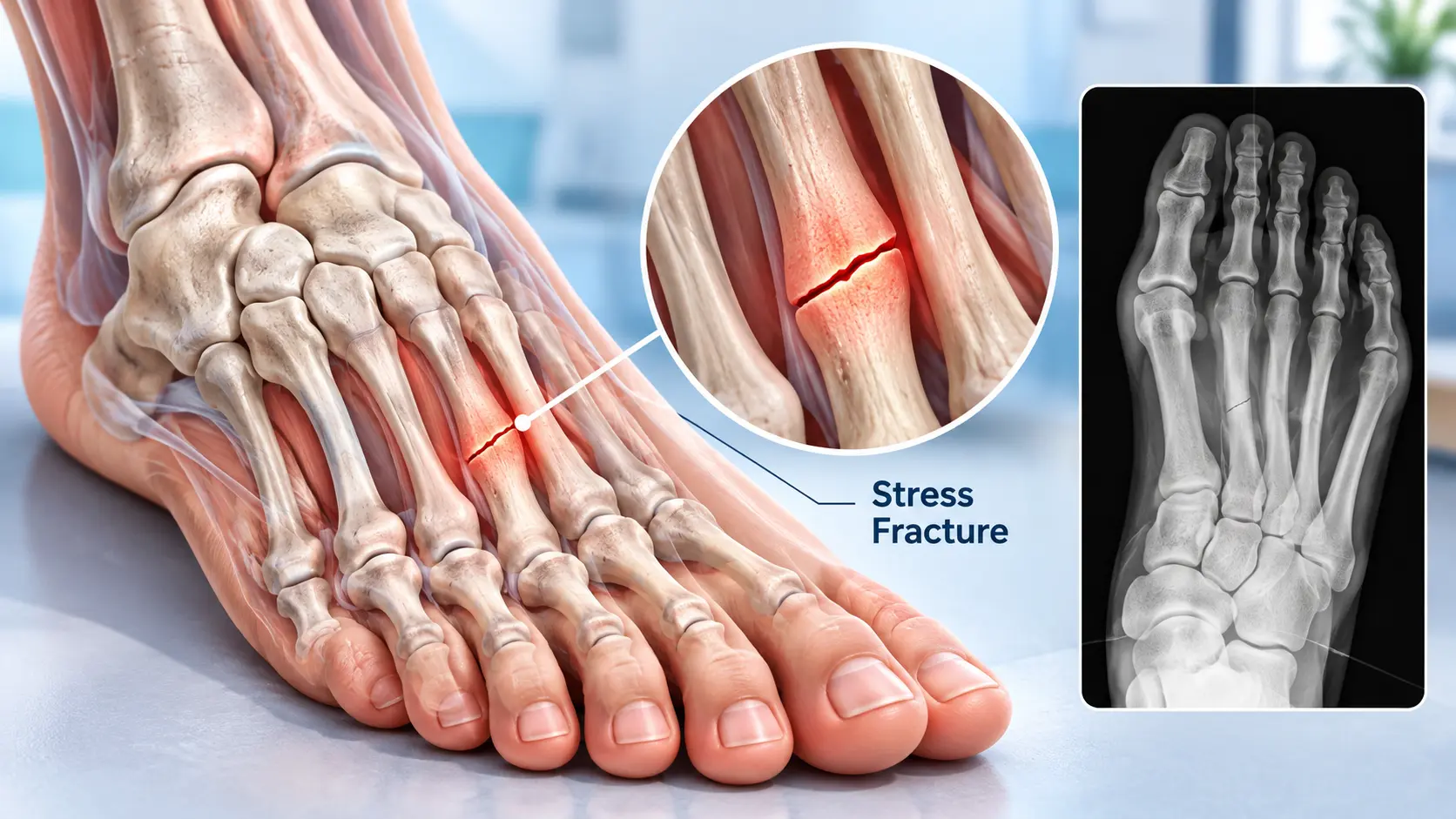
A stress fracture foot problem most often involves the metatarsals, the long bones at the front of the foot. The typical sign is a dull pain that grows with walking or standing and eases with rest, sometimes with swelling and a tender spot over the bone.
NHS trust guidance on foot stress fractures says a healthcare professional can usually tell from your symptoms and how they started, and that some people are diagnosed without an X-ray at all. It also notes that not every stress fracture shows on an X-ray, because the changes can be too small to see at first. A new pair of shoes, a sudden increase in walking, or restarting a sport after a long break are all common triggers.
Signs of Stress Fracture Foot You Can Check Yourself
Signs of stress fracture foot are easy to miss because each one can seem minor. Look out for:
- Pain that builds as you walk or stand and eases when you rest
- Swelling on the top or side of the foot
- A sore spot on a bone when you press it
- A change in how you walk, such as favouring the foot
- Pain that began after a jump in training, new footwear or a long break from exercise
None of these proves a fracture, and several can come from a strain or a tendon problem. Together, though, they are a good reason to be examined instead of waiting. If you cannot put weight on the foot at all, that needs prompt assessment. Even when you can walk, a spot that stays tender for more than a week or two despite rest is worth having looked at, because the longer a stress fracture is loaded, the longer it takes to settle.
Stress Fracture Heel Pain and What Sets It Apart
Stress fracture heel pain tends to sit on the inner or outer side of the heel bone and increases with impact such as walking briskly or running. A stress fracture heel problem is less common than other causes of heel pain, so the examination matters.
The usual first step is a period of rest, which may include crutches or a protective boot. Because heel pain has several different causes, we look at where exactly it hurts, what makes it worse and whether pressing on the bone reproduces it. That is one reason we never guess from a description alone.
Stress Fracture Shin or Shin Splints, How to Tell Them Apart
A stress fracture shin problem and shin splints can feel alike, and the difference matters because the advice differs. Shin splints cause pain and tenderness along the front of the lower leg, usually from exercise. A stress fracture is more often a sore, tender spot on the bone in one place.
The NHS describes shin splints as usually not serious, diagnosed by examining the leg and asking about your symptoms, and usually better within a few weeks. It also says to get help from 111 if the pain is severe or you have injured your shin.
A stress fracture in the shin does not always settle on that timetable, and pain that stays in one spot, keeps building or is present at night needs a proper check. One practical clue is size: pain spread over a long stretch of the shin often points to shin splints, while pain you can cover with a fingertip points more towards the bone. That is only a clue and not a diagnosis, so the examination still decides. If a lump appeared after a knock instead, our guide to a lump on the shin covers that separate situation.
Hip Stress Fracture and Why Groin Pain Needs Prompt Attention
A hip stress fracture is uncommon, but it is the kind we take most seriously. The top of the thigh bone can crack under repeated load, and if it is missed it can progress to a full break. Groin pain with a stiff or restricted hip, especially in a runner, is the pattern to be seen for.
Doctors describe this as an injury to consider whenever someone has groin pain and reduced hip movement. It is not always tender to press, because the area is well padded, so the examination and the history carry a lot of weight. If you cannot put weight on the leg, go to A&E or call 999. Not every hip ache is a bone problem, though. Outer hip pain is often something like hip bursitis, which is why a clinician sorts out the source first.
Stress Fracture Thigh Bone and What the Higher Risk Means
A stress fracture thigh bone injury at the neck of the femur is one of the higher-risk sites. Higher risk means the bone has a poorer blood supply or higher forces, so it heals less reliably and is more likely to progress to a complete break.
When this is suspected, doctors recommend an MRI, because it shows what type of fracture it is and that decides the plan. Some need surgery, and recovery often takes several months and can take longer in more severe cases. That is a reason to be seen promptly and to avoid running, not a reason to panic. Most people with a thigh bone stress fracture make a full recovery over a period of months, and the whole point of an early check is to catch the injury while it is still manageable. The same extra care applies to a few other sites, including the middle of the shin bone, the inner ankle bone and a bone in the midfoot called the navicular.
What Causes a Stress Fracture in the First Place?
What causes a stress fracture? Repeated stress on a bone that renews itself more slowly than it is being loaded. Bone is always rebuilding, and a stress fracture can develop when the load rises faster than that repair can keep up.
NHS trust guidance lists doing an activity you have not done before or for a long time, increasing it quickly, changing footwear, and returning to normal activity after a spell of doing much less. Health conditions that weaken bone, low bone density, having been through the menopause and eating disorders raise the risk too. You can read more about our clinic and the clinicians who look into these causes with you. Finding the cause matters as much as treating the crack, because a bone that is overloaded again will simply crack again.
What Causes Stress Fracture in Runners and Beginners?
What causes stress fracture in runners often comes down to volume and surface. Doctors report that stress fractures account for nearly one in six running injuries, most often in the shin bone, a midfoot bone and the metatarsals. A sudden jump in distance, speed or hill work is the usual pattern.
Beginners meet the same problem from the other direction. A bone that has not been loaded for months is not ready for an enthusiastic first week, so the load climbs faster than the bone can adapt. The remedy in both cases is the same idea: build up gradually, vary the surface where you can, and tell a clinician early if one spot starts to nag.
How Long Does a Stress Fracture Take to Heal?
How long does a stress fracture take to heal? For a foot, NHS trust guidance says between 6 weeks and 6 months, with up to a year before returning to high-impact sport. Doctors also describe resting from the aggravating activity for at least 4 to 8 weeks, sometimes up to 12. Higher-risk sites usually take longer.
Those ranges are wide because the bone, the site and the load all differ. Recovery usually means reducing the load, which may involve a boot, crutches or simply changing what you do. Light, pain-free exercise such as swimming or cycling is often fine. Smoking slows healing, so cutting down helps.
In the first weeks the priority is rest from the aggravating activity, while keeping the rest of the body moving. Then comes a gradual return, starting with low-impact exercise and building up in steps, with running only added back once everyday walking is pain-free.
Once walking is painless, physiotherapy helps rebuild strength and a safe return to impact. When you do return, increase only one thing at a time and by roughly a tenth per session. If you still have a lot of pain or swelling after about six weeks, get the injury reviewed.

Suspect a Stress Fracture? Book a Same Day Review at Bilba Clinic
Bilba Clinic is a CQC-registered private clinic in Fitzrovia, London, offering medical, aesthetic and wellbeing care from experienced clinicians. We are recognised by major insurers including Bupa, Vitality and WPA, and we also see self-pay patients who prefer to book directly.
If you suspect a stress fracture, we examine the area, ask about your training and recent changes, and explain what we find. If imaging would change your care, we refer you for it, and we say plainly when it would not. Same day appointments are often available, and the aim of the first visit is simple: a clear answer about what is going on and what to do next, whether that is rest, a rehabilitation plan or a scan.
Costs vary with what you need, so we would rather give you an accurate figure after a proper look. As a general guide, an initial consultation with our sports medicine team starts at £300, an MRI reading is £180, and physiotherapy is £80 for 30 minutes or £120 for 60 minutes. Our pricing page has the current figures.
To book:
- Address: 57 Great Titchfield Street, Fitzrovia, London W1W 7PN
- Phone: +44 (0) 7858 848 244
- Email: info@bilbaclinic.co.uk
- Opening hours: Monday to Friday 10:00 to 18:00, Saturday 12:00 to 17:00, Sunday closed
You can also book online or get in touch with any questions before your visit.
Frequently Asked Questions
Does Stress Fracture Pain Come and Go?
Yes, often. Stress fracture pain usually builds with activity and eases with rest, and some people feel it at the start of a session, lose it while warm and feel it again afterwards. The pain easing does not mean the bone has healed, because a rested crack can feel fine until the load goes back on. If it keeps returning in the same spot, get it checked.
Can a Stress Fracture Get Worse?
Yes. People often ask can stress fracture get worse if they keep going, and it can. Doctors note that a stress fracture can progress to a full break if it is not managed correctly, and that missed higher-risk sites can have serious consequences. Resting from the aggravating activity and getting a diagnosis early lowers that risk.
Will an X-ray Show a Stress Fracture, or Do I Need an MRI?
Not always. Plain X-rays have low sensitivity for stress fractures, and changes may not show until healing is well under way. An MRI is highly sensitive and is the method of choice when it is available. A private GP or an NHS GP can assess you and arrange the right test.
Can You Walk or Run on a Stress Fracture?
Walking short distances may be possible, but running on a suspected stress fracture is not advised, especially before it has been diagnosed. Doctors recommend resting from the aggravating activity, and lower-impact options such as swimming or cycling are often fine. If walking is painful or you are limping, get assessed.