Found a hip bursitis lump, or a swelling on the side of your hip that you think might be bursitis? It helps to know early that a visible lump is not the usual picture. Hip bursitis mostly shows up as pain on the outer hip, and the bursa sits deep under muscle and tendon, so it rarely pushes out as a bump you can see. A lump in that area is more often something else, which is why a proper scan matters. It shows whether you are dealing with fluid, solid tissue, or irritated tendons, and that decides what happens next.
Short answer: a visible hip lump is rarely caused by bursitis. Hip bursitis usually means deep outer-hip pain, so a lump you can see or feel is worth a scan to find out what it is.
A quick way to tell the main possibilities apart:
- A deep, tender ache on the outer hip that is worse lying on that side, with little or nothing to see: usually hip bursitis
- A soft, smooth lump that moves under your finger and does not hurt: more likely a lipoma or a cyst
- A bulge in the groin or the top of the thigh: can be a hernia or a swollen gland, which need a different kind of check
Hip Bursitis Symptoms, What You Will Actually Feel
Hip bursitis symptoms usually centre on the bony point on the outside of the hip. The pain tends to show up when you walk, climb stairs or push up from a chair, and lying on that side at night is often the hardest part. The spot is tender to press, and the ache can spread down the outer thigh. Most people describe it as a dull, deep ache rather than a sharp stab.
The pattern over a day is useful too. Many people feel stiff and sore when they first get going, ease off a little once they warm up, and then find the ache returns after a long walk or an evening on the sofa. Sleep is often the clearest clue: if rolling onto the painful side wakes you, or you wake after a few hours with a throbbing outer hip, that fits the typical picture far better than a skin-level lump would.
It also tends to travel with other problems. NHS guidance links it with low back pain, knee osteoarthritis, rheumatoid arthritis and fibromyalgia, so a sore hip is not always a hip problem on its own. When you see our clinical team, we start by asking exactly where the pain sits and what makes it worse, because that pattern points towards the cause before any scan does.
Inflamed Bursa in Hip, What Is Actually Happening Inside
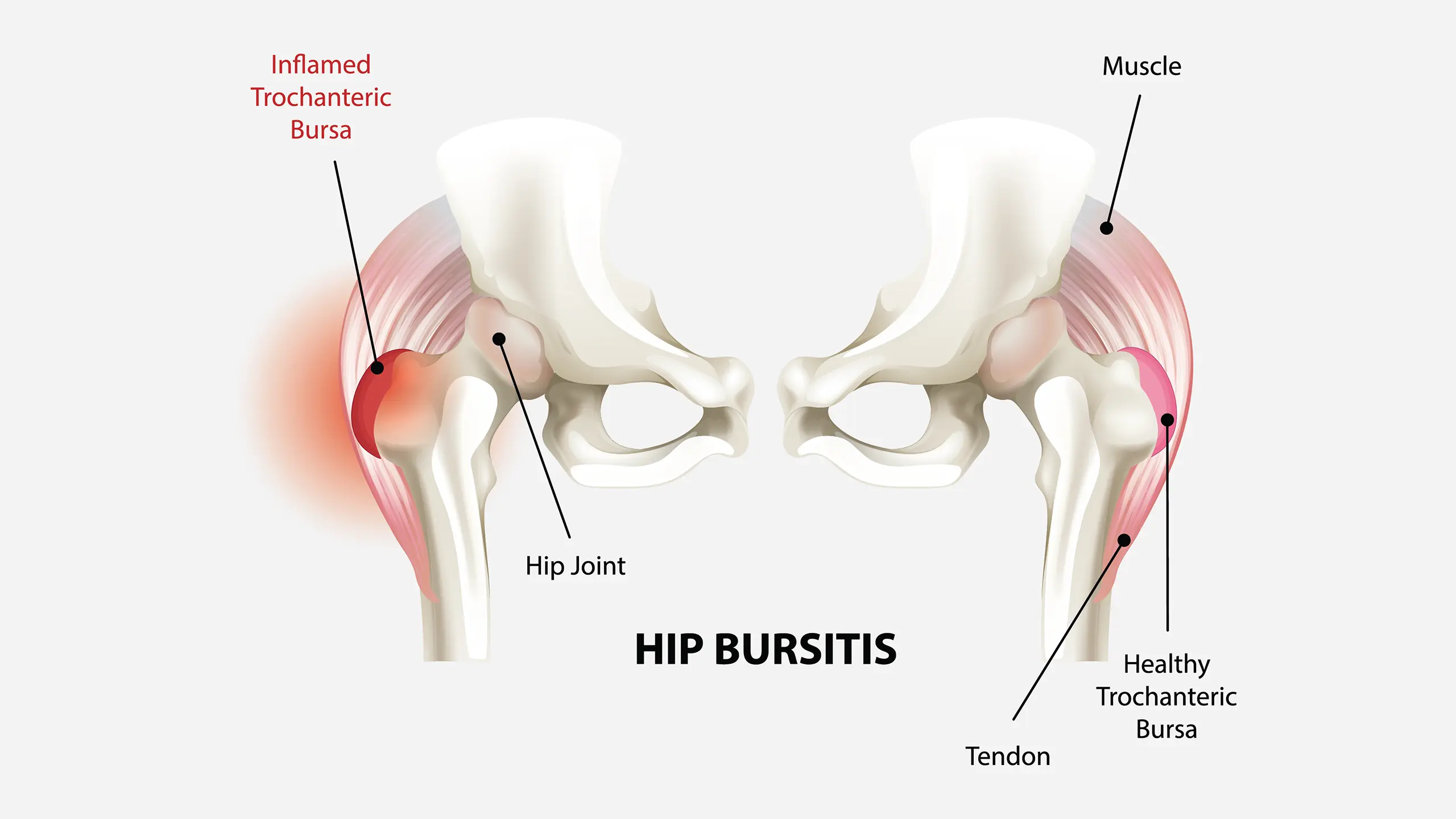
A bursa is a small, fluid-filled sac that cushions the gap between a bone and the muscles or tendons gliding over it. You have several around each hip. When one becomes irritated, it can produce extra fluid and turn tender, which is why pressing on the area hurts and why the pain grows with repeated movement. Doctors call this bursitis. The sac itself is small and sits deep, so even a properly irritated one often gives you pain long before it gives you anything to look at.
What Causes a Bursa on the Hip to Become Sore?
Most of the time there is no single event. Repeated pressure or friction over the outer hip, from long walks, running, stairs or lying on one side, can irritate the area, and a direct knock or a fall can do the same. Excess body weight adds load to the joint, and a sudden jump in activity does too.
Everyday habits matter as well. Standing with your weight on one hip, crossing your legs for long periods, sitting on hard surfaces or limping from an unrelated knee or foot problem can keep the outer hip under strain. Weak hip muscles, a difference in leg length or a stiff lower back also change how load travels through the joint, so the cause of one tender hip often sits somewhere else.
Doctors also use the name greater trochanteric pain syndrome, because the pain can come from the tendons and other tissue beside the bursa, not only the bursa itself. NHS Scotland’s guidance describes the cause as inflammation or physical trauma in the muscles, tendons, fascia or bursae. Questions like what causes bursa to swell have a similar answer: irritation or injury makes the sac produce more fluid, and anything that keeps pressing on it keeps the cycle going.
Pain right where a tendon meets the bone can feel almost identical to a sore bursa, and our guide to tendon attachment pain explains how the two differ and why telling them apart changes the treatment.
Hip Bursitis Swelling, Why You Rarely See a Lump
Hip bursitis swelling sounds as if it should be easy to spot, but it usually is not. The NHS Scotland guidance on trochanteric bursitis says it rarely causes visible swelling, warmth or redness, and that the long-lasting form is the most common. The bursa sits deep beneath thick muscle and tendon, so the extra fluid has nowhere obvious to push outwards.
None of that means a swelling is harmless. It means that if you can clearly see or feel a distinct bump on your hip, bursitis is only one of several explanations, and not necessarily the likeliest. The next section covers the others. If the bump is also hot, red or getting steadily bigger, skip ahead to the red flags below.
What Would Cause a Lump on My Hip If It Is Not Bursitis?
If you are asking what would cause a lump on my hip when bursitis does not fit, the usual answers are harmless ones. A lipoma is a soft, doughy collection of fat cells that sits just under the skin, grows slowly and rarely hurts. A cyst often feels firmer, a bit like a small pea anchored under the surface. After a fall, a pool of blood called a haematoma can raise a firm, tender lump that settles over a few weeks.
Closer to the groin, the list changes. A lump at the top of the thigh can be a hernia, where tissue pushes through a weak spot in the muscle wall, or a swollen lymph gland reacting to an infection elsewhere. These need a different kind of examination from a bursa problem, which is one reason we do not guess from the description alone.
A trochanteric bursitis lump is possible, but because swelling is uncommon with this condition, a clearly visible lump with no outer-hip pain makes another cause more likely. Our guide to a lump under skin on thigh covers lipomas, cysts and groin lumps in more detail if that sounds closer to what you have.
A few simple observations help whoever examines you. Note whether the lump moves under your finger, whether it changes size through the day, whether pressing it hurts, and how long it has been there. A lump that appeared recently after a knock behaves differently from one that has been slowly growing for months. Having those answers ready makes the appointment quicker and the scan more targeted.

Hip Bursitis on Ultrasound, What a Scan Can and Cannot Show
Hip bursitis on ultrasound is one of the quickest ways to see what is going on. An ultrasound uses sound waves to build a live picture of the tissue under your skin, so it can show whether a swelling is fluid or solid tissue and exactly where it sits. People often ask can ultrasound detect hip bursitis, and the honest answer is that it can often show fluid in an irritated bursa, although a deep bursa can be harder to see.
A scan also has limits. One that shows no fluid does not rule out pain from the tendons beside the bursa, which is a common source of outer-hip pain. That is why we read the picture alongside your history and an examination, and do not treat the image as the whole answer.
At the appointment, you lie comfortably while the clinician moves a small probe with gel over the outer hip. It is painless apart from gentle pressure over a tender spot. The clinician sees the bursa, the tendons and the tissue under the skin in real time, and may ask you to move the leg. You usually leave knowing whether there is fluid, a solid lump or neither, and what to do next.
If you would rather know than wonder, you can book online for a consultation and ultrasound at our Fitzrovia clinic.
How Is Hip Bursitis Diagnosed?
Usually from your story and a physical examination. A clinician presses around the outer hip to find the tender spot and checks how the hip moves. The NHS says a GP may take a sample of fluid with a needle to test for infection and conditions such as gout, and you may have blood tests or a scan. An X-ray is often used first to rule out other hip problems.
You can read more about our clinic and the clinicians who carry out these assessments before you book. Everything starts with the same questions: when it began, what it feels like, and whether anything has changed.
When Is a Painful Hip Swelling a Red Flag?
Most hip bursitis settles without drama, but a few signs mean you should not wait. Get prompt medical advice if:
- You have a high temperature, or you feel hot, cold or shivery
- You cannot put weight on the leg or cannot move the hip
- The pain began after a fall
- The pain is very severe, sharp or shooting
The NHS also says to see a GP if symptoms have not improved, or are getting worse, after one to two weeks of treating them yourself.
Infected Bursa in Hip, the Signs That Need Prompt Care
An infected bursa in hip tissue is uncommon, but it is the one form that cannot wait. Septic hip bursitis symptoms include a fever, or feeling hot, cold and shivery, alongside worsening pain and warmth around the area. Infection is treated with antibiotics, usually for at least seven days, and a steroid injection is not given into an infected bursa. If you have these symptoms, contact a doctor the same day and do not wait for an appointment slot.
What Actually Helps a Sore Hip Bursa?
The encouraging part is that most hip bursitis improves with simple, non-invasive care. NHS Scotland’s guidance calls it self-limiting, and says over 90 percent of people with greater trochanteric pain syndrome recover fully with conservative treatment such as rest, pain relief and physiotherapy. Some people do keep having trouble, which is why a plan matters more than hoping it fades.
Our sports medicine team usually works through the same order the guidance does: ease the load on the area, calm the pain, build strength, and only then consider anything more.
How to Treat Inflamed Bursa in Hip Pain, at Home and in Clinic
At home, start by avoiding what aggravates it, such as repetitive hip movements and lying on the sore side. Wrap an ice pack in a tea towel and hold it on the area for around ten minutes at a time, use over-the-counter pain relief if it suits you, and put extra cushioning around the joint when you sleep. Losing weight, if that applies, takes pressure off the joint over time.
In clinic, physiotherapy is the usual next step, because strengthening the muscles around the hip is what protects against a repeat. A physiotherapist looks at how you stand, walk and climb stairs, then builds a graded programme around the glutes and outer thigh, with advice on sleeping position and a safe return to walking, running or the gym.
Shockwave therapy aimed at the outer hip is another option. An image-guided injection can bring short-term relief; one UK GP-written guide reports a benefit lasting up to about three months, strongest at around six weeks, with pain often returning, so we treat it as a way to make rehabilitation possible and not a cure.
Questions about female hip bursitis symptoms treatment make sense, because NHS Scotland’s guide says the condition is more common in women than men, especially between the ages of 40 and 60. The first-line steps are the same ones above, and your clinician will adjust them to your health and activity.

Hip Lump or Hip Pain? Get a Proper Scan at Bilba Clinic in Fitzrovia
Bilba Clinic is a CQC-registered private clinic in Fitzrovia, London, offering medical, aesthetic and wellbeing care from experienced clinicians. We are recognised by major insurers including Bupa, Vitality and WPA, and we also see self-pay patients who prefer to book directly.
If you are not sure whether your hip problem is bursitis, a tendon issue or a lump of a different kind, a consultation and a scan usually settle it. We examine the hip, ask about your history, and use ultrasound to show what sits under the skin before suggesting any treatment.
Costs vary with what is going on, so we would rather give you an accurate figure after a proper look. As a general guide, an initial consultation with our sports medicine team starts at £300, a joint ultrasound at £360, shockwave therapy for the outer hip at £150, and an image-guided injection from £715. Our pricing page has the current figures.
To book:
- Address: 57 Great Titchfield Street, Fitzrovia, London W1W 7PN
- Phone: +44 (0) 7858 848 244
- Email: info@bilbaclinic.co.uk
- Opening hours: Monday to Friday 10:00 to 18:00, Saturday 12:00 to 17:00, Sunday closed
You can also book online or get in touch with any questions before your visit.
Frequently Asked Questions
How Long Does Trochanteric Bursitis Last?
Most cases settle within a few weeks, though some last several months. Recovery tends to be slower if the pain has been there a long time, if hip movement is quite limited, if you are older, or if you have had episodes before. Pain that has not eased after a few weeks of sensible self-care is a good reason to have it assessed. Patient.info, a UK GP-written guide, says it usually lasts a few weeks but can last several months, so a slow recovery is not unusual and does not by itself mean something is wrong.
Can Hip Bursitis Be Chronic?
Yes. NHS Scotland’s guidance describes the long-term form as the most common presentation, and notes that some people continue to have difficulty even after treatment. A chronic case usually calls for a closer look at the tendons and muscles around the hip, and a structured plan, not another round of rest. If the same hip has flared more than once, or the pain has settled in for months, that is the point at which a scan and a rehabilitation plan tend to be more useful than repeating what has not worked.
Should I Keep Moving With Hip Bursitis?
Gentle movement is fine, and complete rest rarely helps. What to avoid is whatever sets the pain off, mainly repetitive hip movements and lying on the sore side. If a walk or a stretch keeps the ache steady, carry on; if it flares each time, scale back and ask for advice on what to do instead.
When Should I Worry About a Lump on My Hip?
See a GP if the lump gets bigger, becomes painful, red or hot, feels hard and does not move, lasts more than two weeks, or grows back after being removed. Any lump together with a fever, or after a fall with trouble bearing weight, needs prompt attention. A lump that is soft, painless and unchanged is usually harmless, but it is still worth confirming with an examination.