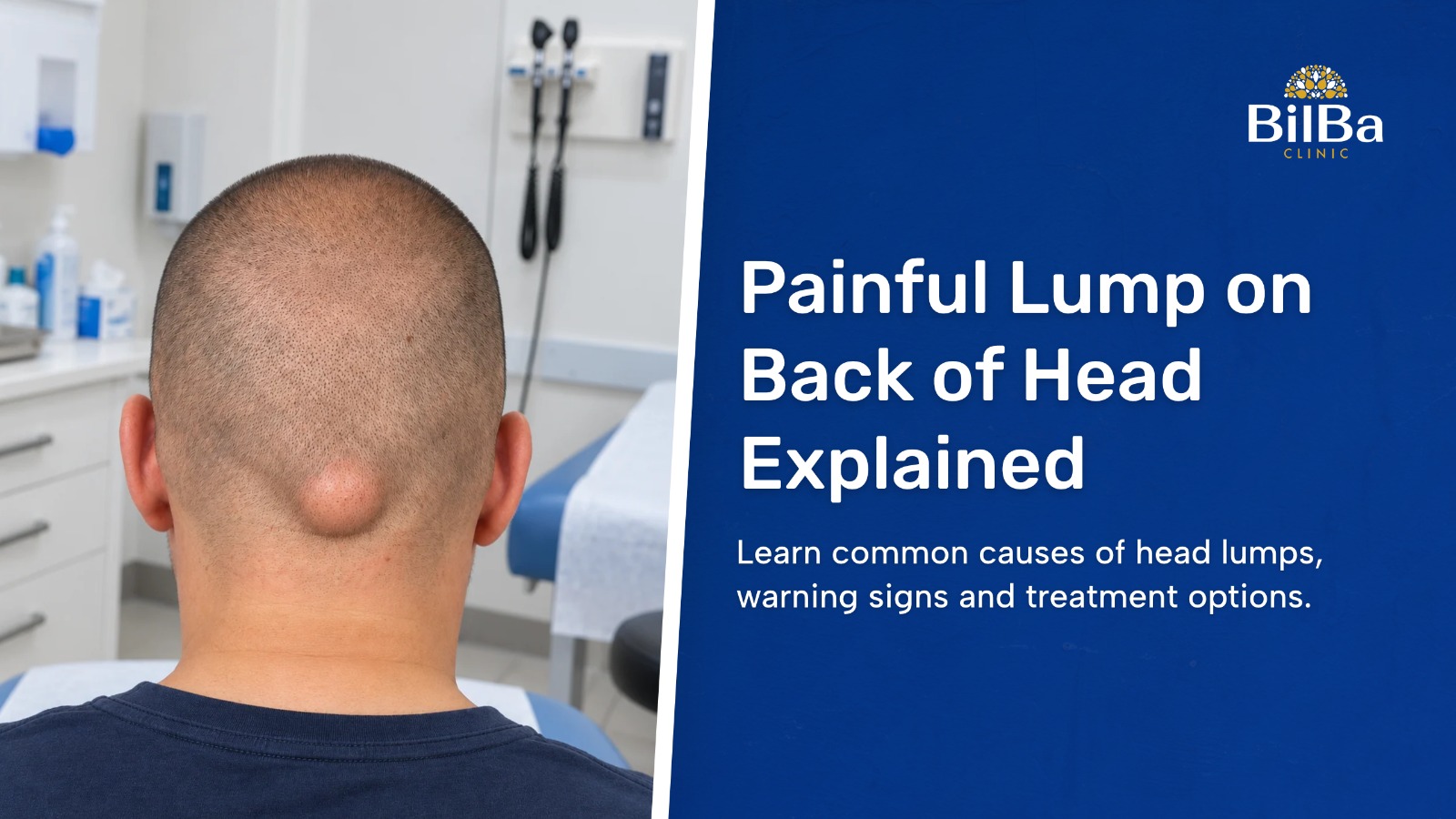
Most of the time, a lump on back of head turns out to be harmless. It is usually a cyst, a lipoma, a swollen gland or the firm bony ridge that sits at the base of the skull in many people. A proper look settles which one you have, and that decides whether you need to do anything at all. At Bilba Clinic we assess these lumps every week, and our minor skin surgery service can remove most suitable ones as a day case. A consultation starts from £300, and cyst removal starts from £900. This guide explains what each type of lump feels like, which signs need faster attention, and what assessment and removal involve.
You can often tell the main possibilities apart by feel:
- Soft, squishy and slightly movable usually points to a lipoma, which is a lump of fat cells.
- Smooth and round, sometimes with a tiny dark spot in the middle, usually points to a skin cyst.
- Firm, fixed and unchanged for years at the very base of the skull is often the natural bony ridge.
- Tender and a little movable, with a cold or sore throat around the same time, can be a swollen gland.
Feel alone is never enough to be sure, so the sections below explain what else to look for.
What Causes Bump on Back of Head and Which Are Common?
Most bumps here have an ordinary cause. The usual suspects are skin cysts, lipomas, swollen glands after an infection, a swelling after a knock, and the natural bony ridge at the base of the skull. Serious causes are uncommon, but they exist, which is why a lump that changes deserves a proper examination.
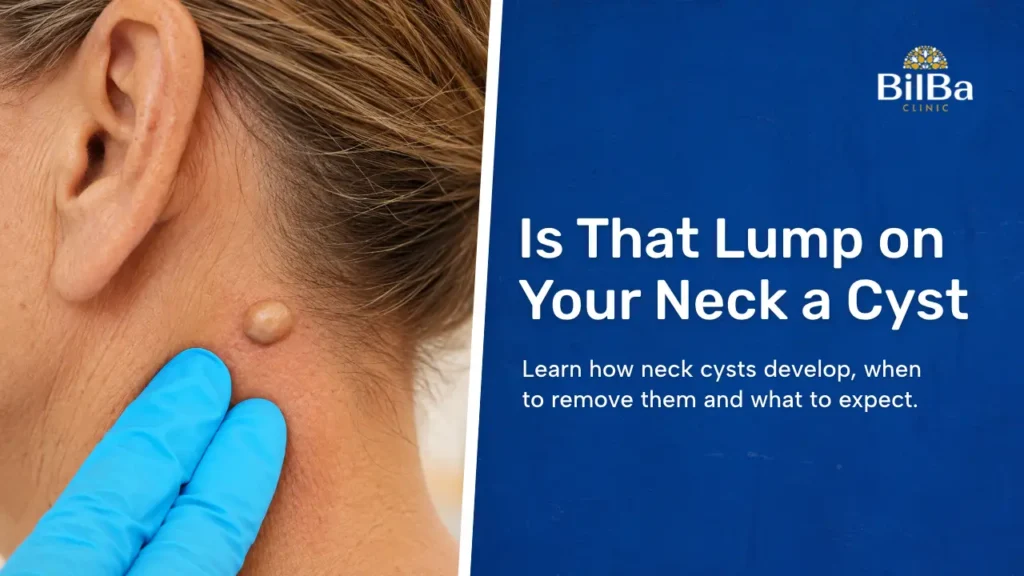
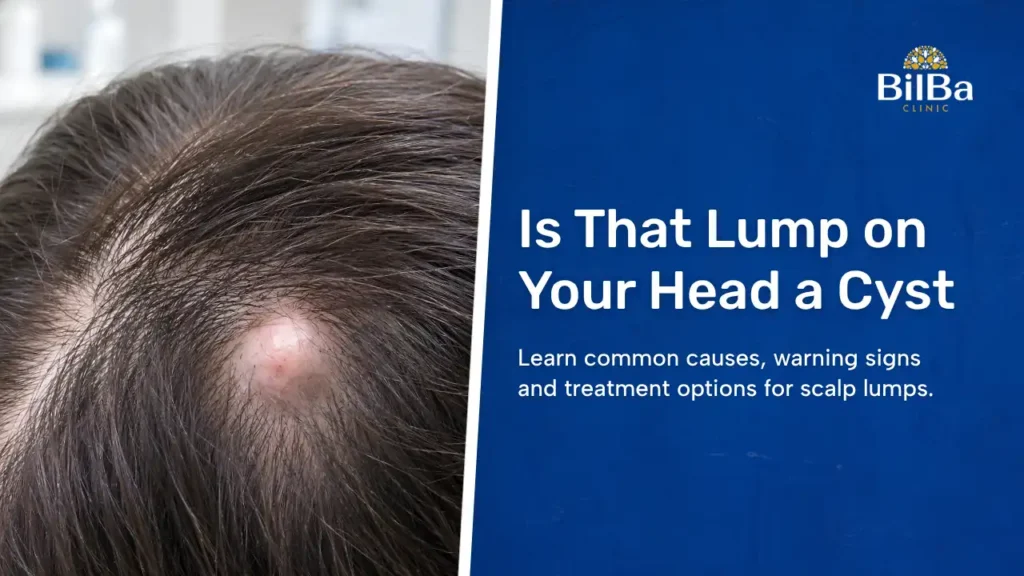
Cysts are the most frequent finding. As NHS skin cyst guidance explains, they are round lumps just under the skin, often filled with fluid or pus. They grow slowly, they are usually harmless, and they do not need treatment unless they cause problems. A cyst that forms in a hair follicle is called a pilar cyst, and these usually appear on the scalp. Cysts are more likely if a family member has them, if you are an adult in middle age, if you are a woman or if you have acne. They are not cancerous, and you cannot catch one from someone else.
Our clinical team sees this kind of lump regularly. The first things we ask are how long it has been there and whether it has changed, because those two answers narrow the list quickly.
Could a Fat Lump on Back of Head Be a Lipoma?
A fat lump on back of head is very often a lipoma, a soft lump of fat cells sitting under the skin. Lipomas feel soft and squishy, move slightly when pressed, are usually painless and grow slowly. They can be anywhere from the size of a pea to a few centimetres across, and they can appear on the forehead as well as the shoulders, back and arms.
Telling a lipoma from a cyst by touch is not always reliable, since a soft cyst can feel similar. Our guide on whether a lump is a cyst or fat deposit explains the feel difference in more detail. When there is any doubt, an examination usually settles it, and an ultrasound scan can be added to confirm what is under the skin. At the back of the head, a lipoma can also be pressed on by a pillow or headrest, which is often the moment people start to notice it.
Is a Hard Lump on Back of Head Bone or a Cyst?
A hard lump on back of head can be bone, a cyst, or occasionally something that needs a closer look. Which one it is depends on whether the lump moves, how long it has been there and whether it has changed. A bony ridge feels firm, stays put and has usually been there for years. A cyst sits just under the skin and may have a small dark spot at its centre.
A hard lump that does not move, or one that is getting bigger, should always be examined, because only an examination can separate harmless bone from something else. If your lump sits higher up on the scalp rather than at the base of the skull, our scalp lump guide covers cysts and lipomas across the whole scalp.
Why Is There a Painful Lump on Back of Head?
A painful lump on back of head most often means an irritated or infected cyst, a swelling after a knock, or a tender gland fighting an infection. Pain deserves attention because it can signal infection. A lump that is sore, red or hot should be examined promptly, and you are welcome to ask us for an early appointment.
An infected cyst typically turns red and sore, and the redness can be harder to see on black or brown skin. Antibiotics may be needed, and squeezing a cyst is best avoided, because a burst cyst can become infected or spread an existing infection. Leave it alone until it has been seen.
Glands behave differently. They swell near an infection, feel tender and usually go down within one to two weeks. A knock to the head can also raise a tender swelling. After a minor head injury, holding a wrapped ice pack to the area for short periods in the first few days can bring the swelling down, and symptoms can last up to two weeks. Never put ice directly on the skin.
We see painful lumps promptly, and you can read more about Bilba Clinic and how we work before you book.
What a Painless Lump on Back of Head Usually Means
A painless lump on back of head is most often a cyst or a lipoma, since both tend to cause no pain. Painless does not mean it can be ignored. Any lump you cannot explain is worth having examined, and a lump that is growing, or hard and fixed, needs checking whether or not it hurts.
One simple habit helps. Take a photo of the lump next to a coin every few weeks. Memory is a poor judge of slow growth, and a photo gives your clinician a clear record to compare.

Does the Size of a Lump on Back of Head Change What Happens Next?
Size on its own rarely settles the diagnosis, but it does shape your options. Growth over time tells us more than the number on a ruler. A tiny lump that has doubled in a month concerns us more than a larger one that has not changed in years.
Is a Small Lump on Back of Head Worth Getting Checked?
A small lump on back of head that is not changing is often fine to watch, but a first check is still sensible. Cysts and lipomas usually start small and grow slowly, and cysts range from smaller than a pea to several centimetres across. A first examination gives you a confirmed diagnosis and a starting point, so any later change is easy to spot.
When a Large Lump on Back of Head Needs a Closer Look
A large lump on back of head is more likely to catch on a comb, press on a pillow or simply bother you. Treatment is often worth considering for a large cyst that interferes with daily life, such as one on the head that catches when you brush your hair.
Large or fast-growing lumps also deserve a scan. Current UK referral guidance for England and Wales asks for an ultrasound within two weeks for an unexplained lump that is increasing in size. Most lumps like this turn out to be harmless, but the scan is how that gets confirmed, and we can arrange one as part of your assessment.
Does Position Matter for a Lump Near the Neck or Behind the Ear?
Position changes the likely causes. Near the neck and behind the ear, glands and muscles sit close to the skin, so the list of possibilities is wider than for a lump higher on the scalp.
What a Lump on Back of Head Near Neck Can Mean
A lump on back of head near neck can still be a cyst or a lipoma, since both can form on the neck and upper back. The head, face, neck, chest and back are all common places for skin cysts.
It can also be a swollen gland. Swollen glands are tender, painful lumps that often follow colds, tonsillitis or ear and throat infections. Glands that keep getting bigger, feel hard or do not move when pressed, come with night sweats or a very high temperature, or appear with no sign of infection should be examined without delay. Difficulty swallowing or breathing is different: that needs emergency medical help straight away.
Is a Lump on Back of Head Behind Ear a Swollen Gland?
It can be. Swollen glands are often caused by common illnesses, including ear infections, and they usually settle within one to two weeks. A lump behind the ear that appears alongside ear pain or a cold is therefore often a gland. A lump that is still there after a week, keeps growing or feels hard should be examined by a specialist, and we are happy to see you.
When Should a Lump on Back of Head Be Seen Urgently?
Seek urgent help if a lump follows a head injury and new symptoms appear, or if the lump becomes red, hot and sore. Seek emergency medical help straight away after a head injury if the person:
- has been knocked out and has not woken up
- cannot stay awake or keep their eyes open
- has a fit
- has clear fluid coming from their ears or nose
- has a dent in their head, or new numbness or weakness in any part of their body
Being sick, feeling dizzy, taking blood-thinning medicine or having been drinking alcohol at the time of the injury also call for prompt medical advice. If you are told to go for emergency care, do not drive yourself.
Without an injury, the picture is different. Searches for lymphoma cancer lump on back of head are common, and the worry behind them is understandable. Cancer of the lymph system, such as lymphoma, is a rare cause of swollen glands. The signs that need prompt examination are glands that keep growing, feel hard or do not move, come with night sweats or a very high temperature, or appear with no sign of infection. Our guide to lump red flags covers the general warning signs for any lump under the skin.
How Is a Lump on Back of Head Assessed at Bilba Clinic?
We start with a conversation and a hands-on examination. We ask how long the lump has been there, whether it has changed, whether it hurts and whether you had a knock. Then we check its size, depth, texture and whether it moves. Many lumps can be identified at this stage.
If there is any doubt, we can arrange an ultrasound scan, which shows whether a lump is solid, fatty or fluid-filled. A scan is the usual next step when the diagnosis is unclear or the lump is growing without explanation.
You do not need a referral to see us. Watching a stable lump is a reasonable choice, since cysts do not need treating if they are not causing problems. We will tell you plainly if that is the sensible route, and we will not push you towards removal.
What Does Lump on Back of Head Removal Involve and Cost?
Removal is a minor day-case procedure under local anaesthetic, so you stay awake but the area is numb. At Bilba Clinic, cyst removal starts from £900, and lipoma excision starts from £1,500 for a small one and £3,000 for a large or deep one. Your consultation, from £300, confirms which applies.
On the day, the steps are simple:
- We confirm the diagnosis and agree the plan with you at consultation.
- The area around the lump is numbed with local anaesthetic.
- The lump is cut out through a small incision, and for a cyst we aim to remove the whole sac.
- The wound is closed with stitches.
- Removed tissue may be sent to a laboratory where clinically appropriate.
Costs vary with the type of lump, its size and how deep it sits. We would rather give you an accurate figure after examining you, and our pricing page is a general starting guide. Removal of a large, painful cyst that makes daily tasks difficult is a sound medical reason to go ahead, while removal of a cyst that only bothers you for appearance is a personal choice, and either way the decision is yours.
Removal swaps a lump for a small scar, and new cysts may form elsewhere in future. A cyst can also occasionally regrow at the same site. Taking the whole sac is the best way to lower that chance. For a step-by-step walkthrough of scalp cyst removal and recovery, see our guide to scalp cyst removal.
Lump on Back of Head Assessment and Removal in London at Bilba Clinic

Bilba Clinic is a CQC-registered private clinic in Fitzrovia, London, offering medical, aesthetic and wellbeing care from experienced clinicians. We are recognised by major insurers including Bupa, Vitality and WPA, alongside self-pay patients.
If you have found a lump on the back of your head and are not sure what it is, we will examine it properly before suggesting anything. You will get a clear explanation of what we find, an honest view on whether to watch or remove it, and a price before any procedure. Appointments are unhurried, so there is time for questions. When you are ready, you can book online, or get in touch first if you would like to ask something before booking.
- Address: 57 Great Titchfield Street, Fitzrovia, London W1W 7PN
- Phone: +44 (0) 7858 848 244
- Email: info@bilbaclinic.co.uk
- Opening hours: Monday to Friday 10:00 to 18:00, Saturday 12:00 to 17:00, Sunday closed
What Do Patients Ask About a Lump on Back of Head?
Lump on Back of Head Hurts When Pressed With No Injury, What Is It?
A lump on back of head that hurts when pressed, with no injury behind it, is often an irritated cyst, an early infection or a tender gland. Tenderness alone cannot tell us which. If the area is red, hot or swelling, ask us for an urgent review. Otherwise, have it examined if the pain lasts more than a week.
How Long Can a Bump on Back of Head Last?
It depends on the cause. A swelling from a knock usually eases over days, and symptoms after a head injury can last up to two weeks, so a review is sensible if they go on longer. A swollen gland usually settles within one to two weeks. Cysts and lipomas grow slowly and usually stay until they are removed.
Is a Lump on Back of Head Causing Headache an Emergency?
Not always, but treat it seriously. After a head injury, vomiting or dizziness needs prompt medical advice, and signs such as being unable to stay awake or clear fluid from the ears or nose need emergency help straight away. With no injury, book an assessment promptly so the lump and the headache are looked at together.
Is Bump on Back of Head Normal If It Doesn’t Hurt?
Sometimes. A firm bony ridge at the base of the skull is normal for many people, and cysts and lipomas are usually painless. A painless bump can still need checking if it is new, growing, or hard and fixed. Any lump you cannot explain is worth having examined.
Do I Need a GP Referral for Lump on Back of Head Removal?
No. You can book with us directly and be assessed without a GP referral, and same-day appointments are often available. We examine the lump first, then explain whether removal, monitoring or a scan is the sensible next step for you.
Will My Lump on Back of Head Be Tested After Removal?
Removed tissue may be sent to a laboratory where clinically appropriate. A removed lipoma may be tested to check it is what it looked like. Testing confirms the diagnosis and gives you a clear answer about what was growing under your skin.