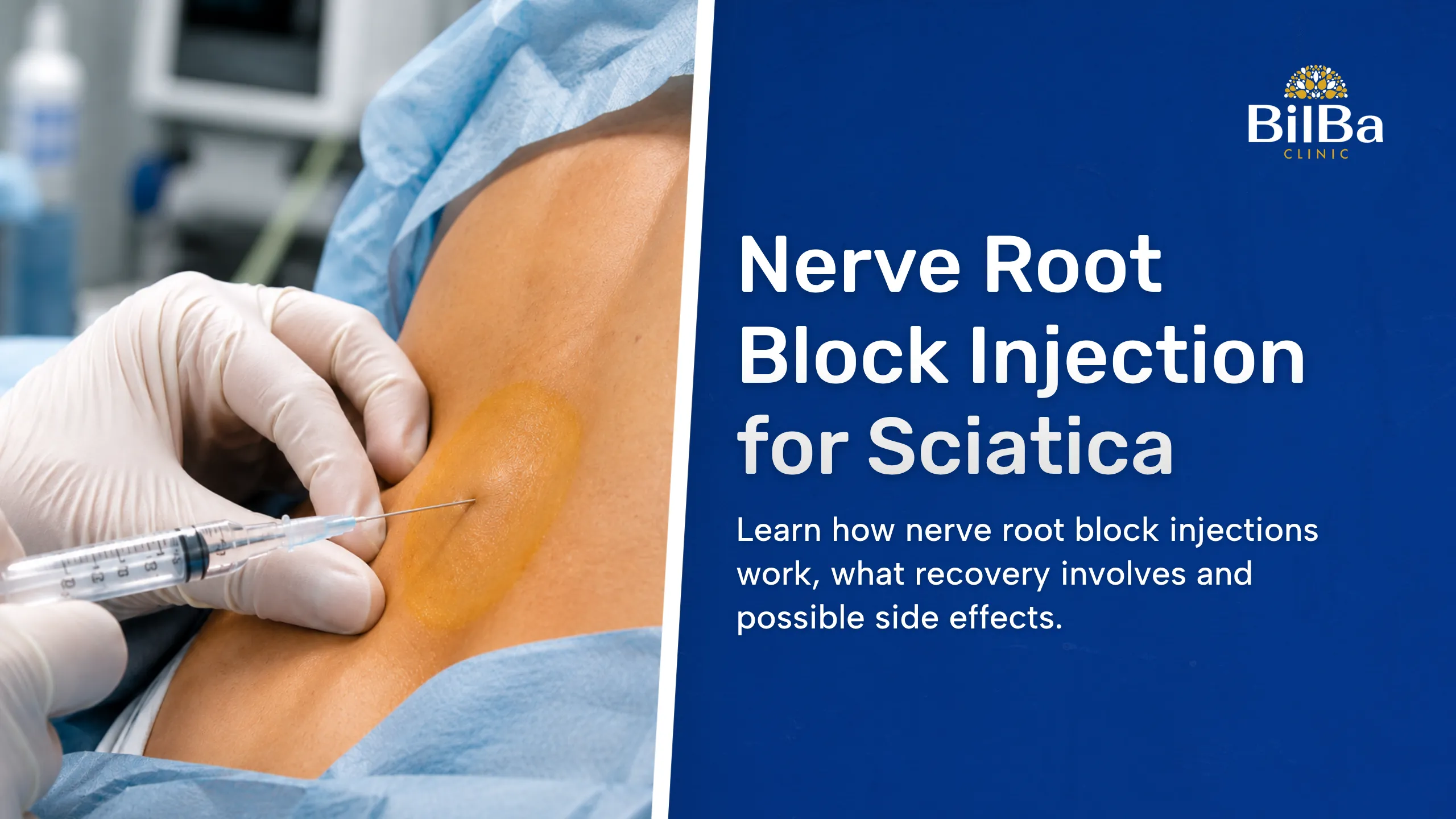
Sciatica can send sharp, burning pain down the back of one leg, and when rest and exercise have not settled it, many people start asking about injections. A nerve root block is one option. It places a small amount of medicine right beside an irritated spinal nerve, with the aim of calming pain where it starts. It does not suit everyone, and it is not a cure. In this guide, we explain how it works, how it compares with an epidural, what recovery looks like and what the risks are. If you are still working out what is behind your leg pain, our sciatica diagnosis guide is a good place to start.
What Is a Nerve Root Block?
A nerve root block is an injection of local anaesthetic, often with a small amount of steroid, placed around one irritated spinal nerve. It is used mainly for sciatica-type leg pain when simpler measures, such as exercise and physiotherapy, have not helped enough. It is also called a nerve root injection. It aims to calm pain, not to cure its cause.
Your spinal nerves leave the spine through small gaps on each side. When a slipped disc or a narrowed gap presses on a nerve root, pain can travel down the leg. The injection is guided by X-ray or ultrasound, so the needle reaches the right spot. It is usually given alongside other care, such as physiotherapy, because easing pain can make movement and rehabilitation easier.
What can it do? For some people it brings clear relief and a window to get moving again. For others the effect is modest or short-lived, and a few feel no change at all. It treats the irritation around the nerve, not the disc or narrowing that caused it, so the underlying problem still needs a plan. That is why we see a nerve root block as one part of a wider sciatica plan and not a stand-alone fix.
Selective Nerve Root Block, and Why the Term Matters
You may see the phrase selective nerve root block. “Selective” means the injection is aimed at one nerve root only, not several. How you respond afterwards is only one piece of the picture, so we weigh it alongside your examination and scans.
Sciatica Treatment Injections, and Where a Nerve Root Block Fits
Sciatica treatment injections usually come after simpler care. Most sciatica improves over a few weeks to a few months with exercise, painkillers and physiotherapy, as NHS sciatica advice explains. Injections are usually considered when pain is severe or lingering and those first steps have not helped enough.
A nerve root block may be worth discussing if:
- your leg pain is stronger than your back pain and follows the path of one nerve
- exercise and physiotherapy have not eased it enough
- the pain is stopping you from working, sleeping or moving normally
- your examination or scan points to an irritated nerve root
Our sports medicine service starts with a full physical assessment, and imaging when it is needed, so any injection is matched to the likely cause and is not a guess. If you already have an MRI, we can review it as part of your assessment. Follow-up reviews can also be done by video call, which helps if you cannot return to the clinic soon after treatment.
The aim is to decide together whether an injection makes sense now, whether more physiotherapy should come first, or whether another cause needs looking at. Sciatica is a symptom, not a diagnosis. A careful examination of your strength, reflexes and sensation tells us far more than a single scan result.
What Goes Into a Steroid Injection for Sciatica?
A steroid injection for sciatica usually combines two medicines. A local anaesthetic numbs the area quickly. A small amount of corticosteroid is added to calm irritation and swelling around the nerve. The exact mix varies from case to case. A little contrast dye is often added so the needle position can be confirmed on X-ray.
The steroid dose is small. Even so, it can have short-lived effects elsewhere in the body, such as facial flushing, changes to periods or a rise in blood sugar. These are more likely with repeated injections. If you have diabetes, tell us before the injection, because your blood sugar may need extra checking afterwards.
The local anaesthetic has a second job. Because it works quickly, you may notice your leg pain ease or change shortly after the injection. That early response can be useful information, but it is short-lived and is not the same as the longer effect the steroid is meant to give. Steroids are widely used for pain in this way. Some routes of giving them sit outside the medicine’s formal licence, so we explain what is being used and why.

How an Epidural Injection for Sciatica Differs
An epidural injection for sciatica places medicine into the epidural space, the area around the nerve roots inside the spine. A nerve root block aims at one nerve root instead. In practice the two overlap, because the medicine from a nerve root block can spread into the epidural space.
Which one fits you depends on how many nerves seem involved and what your examination and scans show. If several levels are irritated, a wider injection may be discussed. If one nerve is clearly the source, a targeted block is often the more natural choice.
There is no single winner. A wider injection is not automatically stronger, and a targeted one is not automatically safer. Both aim at the same goal, which is to reduce nerve irritation enough for you to move, sleep and rehabilitate. Both can fail to help, and both carry similar types of risk, which we cover below.
What a Transforaminal Epidural Injection Is
A transforaminal epidural injection reaches the nerve through the foramen, the small opening where the nerve leaves the spine. This is the route used for a nerve root block, which is why the two names are often used for the same procedure. Our guide to the causes of sciatica lists this injection among several options, and here we go further into how it works.
What Happens During a Nerve Root Block
The details differ between clinics, but the steps below are typical. Before anything is done, we explain your other options, answer your questions and ask for your consent. The decision to go ahead is made together, and you can say no or take time to think.
Before the Injection
We ask about blood-thinning medicines, diabetes, allergies, any current infection, and whether you could be pregnant. Mention it if you plan to fly within two weeks. Arrange for someone to take you home. If you take blood thinners, such as warfarin or apixaban, extra preparation may be needed. A current infection, in the body or on the skin of your back, may mean the injection is delayed until it clears. Keep taking your usual medicines unless we tell you otherwise.
During the Procedure
You lie in position and the skin is cleaned. A local anaesthetic numbs the area, which can sting briefly. Using X-ray or ultrasound, we guide the needle to the nerve and inject the medicine. You may feel pressure or tightness. The procedure often takes around 15 to 20 minutes. If something feels uncomfortable or different, say so straight away. We can adjust or stop.
Straight After the Injection
You rest for a short time while we check how you feel, and you can usually go home within a few hours. Your leg may feel numb or weak for a while. Do not drive yourself home, and avoid driving for the rest of the day. Ideally, have someone with you for the first 24 hours. Avoid alcohol and important decisions, such as signing legal papers, until you feel back to normal.
How Recovery After a Nerve Root Block Usually Goes
Expect some soreness at the injection site for the first couple of days. Keep the area dry for 24 hours. Some people find their pain feels worse for a short while before it settles, so a flare early on does not mean the injection has failed. Stay gently active, such as short walks, and build up slowly. As your pain eases, simple activities like a daily walk, an exercise bike or gentle swimming can help. Rest in bed is not helpful, and neither is doing too much too soon. If you overdo it, pain often shows up the next day, so increase your activity in small steps. Time off work depends on your job and how you feel, so we will talk this through with you. Our HCPC-registered physiotherapist can help you plan this through physiotherapy at Bilba.
What to Expect for L5 Nerve Root Injection Recovery Time
The L5 nerve root sits low in the spine, and irritation there can send pain down the leg. L5 nerve root injection recovery time follows the same general pattern as other levels. Soreness settles soon, but how fast leg pain eases varies. Some people notice a change early, and others need longer to judge the result. We cannot promise a fixed timeline, because it depends on the cause, your health and how much the nerve was inflamed.
Nerve Root Block Side Effects to Know About
Most nerve root block side effects are mild and short-lived. Serious problems are rare. We go through the risks with you before you agree to treatment. If you want to know who would look after you, you can meet our team.
Common effects include:
- tenderness or bruising at the injection site for the first days
- brief numbness or weakness in the leg while the anaesthetic wears off
- flushing, or a temporary change in blood sugar or periods, from the steroid
- feeling faint for a short time afterwards
Less common problems include infection, an allergic reaction, and a headache if the fluid around the spine is accidentally punctured. Very rarely, a nerve can be seriously injured. Injections also do not always work, and a small number of people find their pain is worse for longer than expected.
Contact us if you notice redness, warmth or tenderness at the injection site, or if you feel hot and unwell, because infection needs prompt treatment. A severe headache that does not ease after a day should also be checked. New leg weakness that does not wear off, or loss of bladder or bowel control, needs urgent medical attention.
Is a Nerve Root Block Right for You?
A nerve root block suits pain caused by an irritated nerve root. Not all leg pain comes from there. A tight piriformis muscle can mimic sciatica, as our piriformis injury guide explains, and joint problems can do the same, as our guide to sacroiliac dysfunction causes shows. Other regenerative medicine options may fit some soft tissue problems.
Many people use an injection as a window of lower pain. Once the nerve is calmer, stretching, strengthening and a gradual return to normal activity become easier, and that is where much of the lasting benefit comes from. If your pain returns, tell us how long the relief lasted and what you were doing. That detail helps us decide the next step, whether that is more rehabilitation, further assessment or a different treatment.
An injection may not be suitable if you have an active infection or cannot pause blood-thinning medicine safely. Tell us if you could be pregnant. We will go through these points with you before any decision is made. An injection cannot promise to help you avoid surgery. If you develop new weakness in both legs, numbness around the genitals or bottom, or trouble controlling your bladder or bowels, seek emergency medical help straight away.

Book a Sciatica Assessment at Bilba Clinic
Bilba Clinic is a CQC-registered private clinic in Fitzrovia, London, offering medical, aesthetic and wellbeing care from experienced clinicians. We are recognised by major insurers, including Bupa, Vitality, WPA and AXA, and we welcome self-pay patients too.
If sciatica is limiting your days, a full assessment is the best first step. We examine you, review any scans and explain whether a nerve root block, another treatment or a different plan fits your pain. There is no pressure to book an injection. Costs vary depending on the assessment, imaging and treatment needed, so we would rather give you an accurate figure after a proper look. Our pricing page gives a general starting guide. You can book online or contact us with any questions, and you can read more about Bilba Clinic on our site.
- Address: 57 Great Titchfield Street, Fitzrovia, London W1W 7PN
- Phone: +44 (0) 7858 848 244
- Email: info@bilbaclinic.co.uk
Opening hours:
- Monday to Friday: 10:00 to 18:00
- Saturday: 12:00 to 17:00
- Sunday: closed
Questions About a Nerve Root Block
How Long Does a Nerve Root Block Last?
How long a nerve root block lasts varies from person to person. The numbing effect is short-lived, while the steroid is meant to give a longer effect. Relief is short-lived for some people and lasts much longer for others. It is not a cure, so the underlying cause still needs managing with exercise and physiotherapy.
Is a Nerve Root Block Injection Painful?
Most people feel a short sting when the skin is numbed, then pressure or tightness as the needle is positioned. Mild discomfort is common and brief, and you can tell us if anything feels uncomfortable. Soreness can follow for a couple of days and usually settles with rest.
How Long Does an Epidural Injection Last?
An epidural injection for sciatica works much like a nerve root block, so the answer is similar. How long it lasts depends on the person and the cause. Some feel relief briefly and others for longer, and it does not always work. Whether to repeat it depends on how much it helped. If it made little difference, we may suggest a different approach.
Nerve Root Block vs Epidural, Which One Is Used?
A nerve root block targets one irritated nerve root, while an epidural spreads medicine through the epidural space around the nerve roots. Because a nerve root block can spread into the epidural space, the two overlap. The choice depends on your symptoms, your examination and what your scans show.