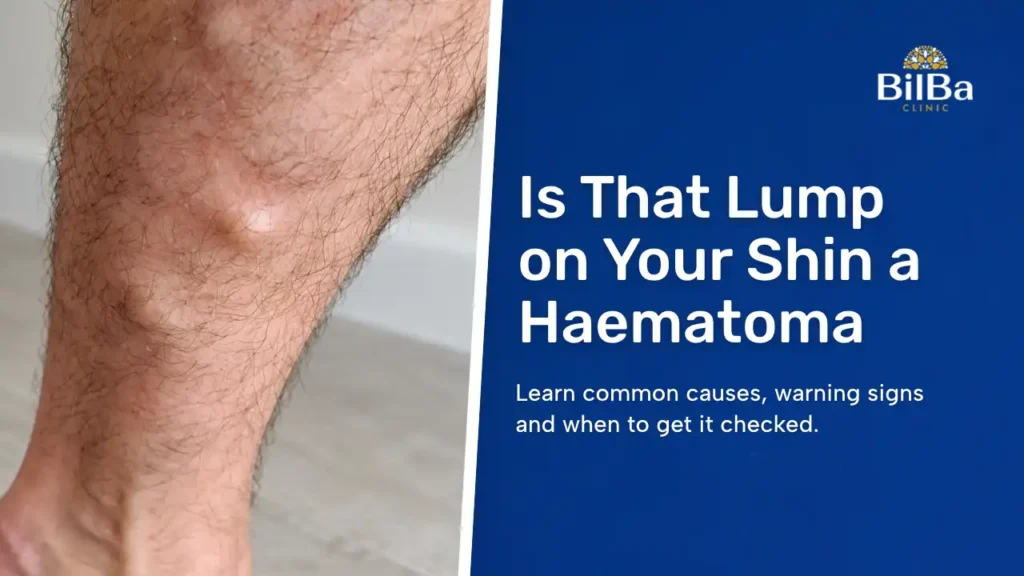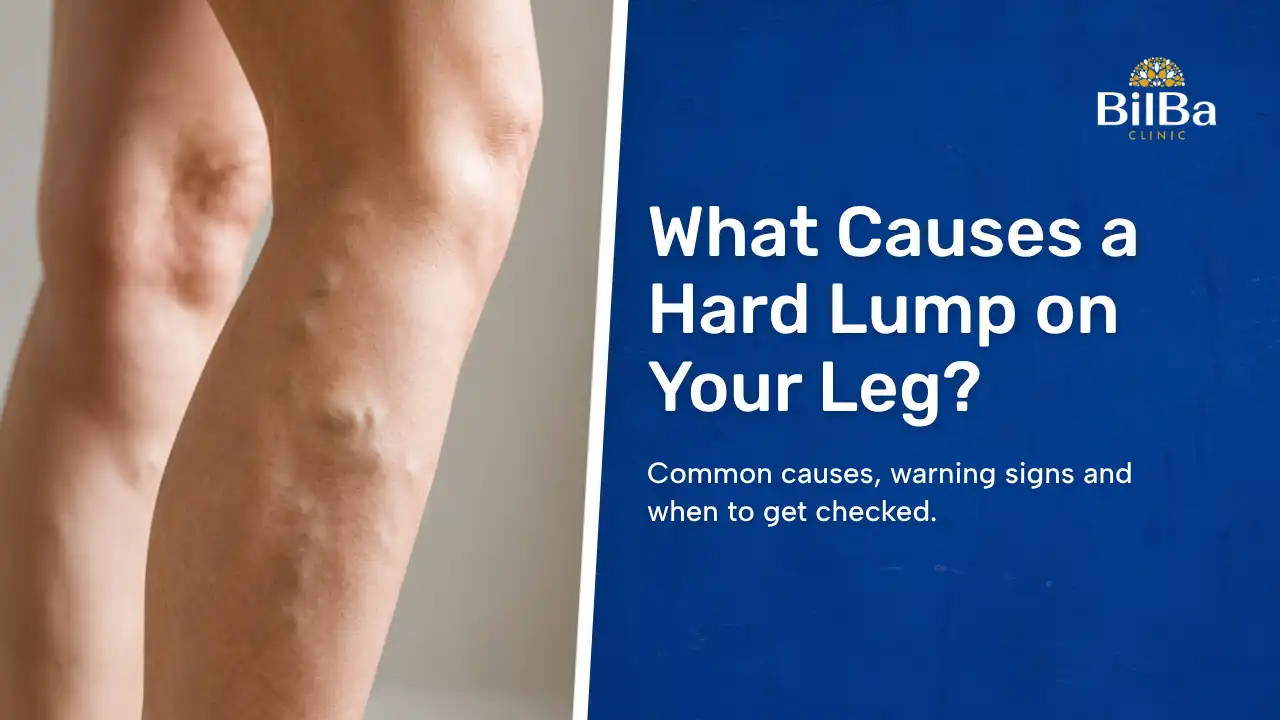
Finding a hard lump under skin on leg is unsettling, especially if it appeared without any injury you remember. The good news is that most of these lumps come from one of a small number of common, non-cancerous causes, a fatty lump called a lipoma, a fluid-filled cyst, a firm scar-like nodule called a fibroma, or a reaction in a vein close to the surface. Where the lump sits, how it feels, and whether it hurts all give real clues about which one you’re dealing with. This guide walks through each possibility so you know what you’re looking at and when it’s worth having a doctor take a proper look. None of this replaces an actual examination, but knowing the general shape of the possibilities makes that conversation a lot less daunting when you do book one.
What Is Causing a Hard Lump Under Skin on Leg
Most hard lumps on the leg fall into one of four categories, and the type of tissue behind the lump changes how it feels under your fingers. A lipoma forms from a small pocket of fat cells growing under the skin. A cyst on leg under skin is a closed sac that fills with fluid or a thick, cheese-like substance called keratin. A fibroma leg lump is a solid knot of fibrous tissue that often follows a small cut, scrape or insect bite you may not even remember having. Less often, swollen glands or a reaction in a blood vessel can feel like a lump too, and we cover both further down. None of these causes are visible from the outside in the way a rash or a cut would be, so the only reliable way to tell them apart is by working through how the lump feels, how it behaves, and where it happens to be sitting.
- Lipoma: soft and slightly springy, moves easily when you press it, rarely painful unless it’s pressing on a nerve
- Cyst: firmer than a lipoma, sometimes with a small dark central point, feels like a small ball sitting just under the skin
- Fibroma: firm all the way through, sits close to the surface, tends to dimple inward if you pinch the skin either side of it
What Is a Lipoma
A lipoma is a benign growth made of fat cells sitting between the skin and the muscle layer. It’s the most common soft tissue lump on the body, and the leg is a frequent spot for one to form. A true lipoma should feel soft and doughy rather than hard, so if what you’re feeling is truly firm and doesn’t move under your fingers, a fibroma or cyst on leg under skin is more likely than a classic lipoma on leg. Lipomas grow slowly, often over months or years, and most stay a similar size for a long time. They don’t usually need treatment unless one becomes uncomfortable, grows quickly, or bothers you for cosmetic reasons, at which point removal is something the team at Bilba Clinic can talk through with you during a proper examination.
Where the Lump Sits Matters
Where a lump sits on your leg narrows things down before you even touch it. A small hard lump under skin on leg near the groin or inner thigh often has a different explanation to one on the shin or calf, mostly because of what sits underneath the skin in each area. If you’re at all unsure what you’re looking at, our medical services team can examine it properly rather than you trying to work it out from a description online. It’s also worth checking whether you have more than one lump, or whether it’s changed since you first noticed it, since both details help narrow the possibilities considerably before anyone even lays a hand on it.
Lump on Inner Leg and Lymph Nodes
A lump on inner leg, particularly up near the groin, is often a lymph node rather than a lipoma or cyst. Lymph nodes are small, bean-shaped glands that sit along the body’s drainage system and swell when they’re dealing with an infection or irritation nearby, often in the foot, lower leg or groin itself. A swollen lymph node usually feels smooth, moveable and tender rather than truly hard, and it tends to settle back down within a couple of weeks once the underlying infection clears. A lymph node that stays swollen for more than two weeks, keeps growing, or feels hard and fixed in place is a different picture from the usual reactive swelling, and it’s worth having examined since a longer list of causes needs ruling out at that point. Common everyday triggers include a small cut or blister on the foot, an ingrown toenail, a fungal infection between the toes, or a scratch that got a bit more irritated than usual, all of which can set off a reactive swelling in the nearest lymph node without you necessarily remembering the original scrape.
Lump on the Shin or Calf
A hard lump under skin on shin bone often feels more obvious simply because there’s very little soft tissue between the skin and the bone in that spot, so even a small cyst or a hard lump on shin under skin stands out more than it would elsewhere. A hard lump on calf under skin has more muscle and fat around it, which is where lipomas most often turn up on the lower leg. A lump under skin on lower leg that’s sat in the same spot for months without changing much is more likely to be a lipoma, cyst or fibroma. A hard lump under skin on lower leg that’s come up quickly alongside swelling, warmth or a colour change is a different picture, and points more towards the vein-related causes covered next. A lump on lower leg shin skin can be a healed injury site too, since the shin is one of the most exposed and frequently knocked parts of the body.
Sore or Painless, What the Feel Tells You
Pain, or the lack of it, is one of the more reliable clues you have. A painless lump under skin on leg that’s stayed roughly the same size for a while fits the usual pattern for a lipoma or a small cyst, both of which sit quietly under the skin without upsetting anything around them. A hard lump under skin on leg not painful is generally lower down the list of things to worry about than one that hurts, though painless doesn’t mean harmless forever, it just tends to mean less urgent.
A sore lump under skin on leg, or a small painful lump under skin on leg, usually means something is irritated, inflamed or infected rather than sitting passively under the skin. A painful hard lump under skin on leg that’s also warm, red or swollen around the edges is more likely to be an infected cyst, an inflamed fibroma, or a vein problem than a plain lipoma. Pain that gets noticeably worse over a few days, especially alongside redness spreading outward, is a sign to get it looked at rather than wait it out. An infected cyst is a common example of this pattern, it can sit quietly for months and then flare up quickly, becoming red, tender and sometimes releasing a small amount of fluid, at which point it needs proper treatment rather than home care.
Could It Be a Vein Problem
A hard lump on vein in leg is a different situation to a lipoma or cyst, because the lump is actually part of the vein wall reacting to irritation or a small clot, rather than a separate growth sitting on top of it. This is called superficial thrombophlebitis, and a superficial thrombophlebitis leg lump forms when a vein close to the skin’s surface becomes inflamed, which is more common than people realise in a leg that already has some varicose veins.
- A hard cord like lump under skin leg that follows the line of a vein rather than sitting as a round ball
- Redness, warmth and tenderness directly over the lump, often worse to touch than a typical cyst or lipoma
- Skin that feels tight or slightly raised along the length of the affected vein
Can a varicose vein feel like a lump on its own, without any inflammation? Yes, a varicose vein can bulge enough to feel like a firm lump, especially when you’re standing, though it usually softens or flattens out when you lie down and prop your leg up, which a true lipoma or cyst won’t do.
Could It Be a Blood Clot
Superficial thrombophlebitis usually involves a small blood clot under skin leg lump, sitting in a vein just beneath the surface. On its own, this is uncomfortable rather than dangerous, and it often settles with simple measures like compression and anti-inflammatory medication over a couple of weeks. This is a different condition altogether to deep vein thrombosis, DVT, a clot forming in a vein deep inside the leg rather than near the surface, and DVT is a medical emergency. The two are easy to confuse by name, so the distinction matters: a superficial clot gives you a hard, tender cord you can feel and often see, while DVT more often causes diffuse swelling, aching and warmth through the whole calf without an obvious lump to point to, and only around half of people with DVT notice clear symptoms at all. If your calf becomes swollen, hot and painful, especially if it’s come on over a day or two and one leg looks different to the other, treat that as urgent and get same-day medical attention rather than waiting to see if it settles.
After a Bruise or Injury
A hard lump on leg under skin after bruise is a fairly common thing to notice once the original bruising has faded. When blood collects under the skin after an impact, it can form a hematoma, a pocket of trapped blood, and if that pocket doesn’t fully reabsorb, the body sometimes lays down calcium within it as part of healing, leaving behind a firm lump that can last for months. A dark lump under skin on leg in the days after an injury is usually just this trapped blood working through the normal colour changes of a bruise, from purple through green to yellow, before it fades. If the lump is still there, still dark, or still growing several weeks after the original injury has otherwise healed, it’s worth having it checked rather than assuming it will keep shrinking on its own, since a small number of these lumps do need draining or removing if they stay hard.
Does the Lump Move
A lump under skin on leg that moves when you press it, sliding a little to one side, generally points towards a lipoma or a lymph node rather than a fibroma or a deeper growth, since both sit fairly loosely in the soft tissue above the muscle. A fibroma, by contrast, is usually anchored more firmly and shifts very little.
A hard lump under skin on leg not visible, one you can only feel and not see, is more likely to be sitting deeper, perhaps within the muscle rather than in the fatty layer just under the skin. Deeper lumps are harder to assess by touch alone, and while most still turn out to be everyday causes like a deeper lipoma, this is one situation where an ultrasound scan earns its place, since it can show what’s underneath without needing to guess. A rough way to check movement yourself is to press gently on either side of the lump and see whether it shifts under your fingers or stays completely still, though this is only ever a starting point and not a substitute for someone with training feeling it properly. If you’re unsure which category yours falls into, our wider guide on when to get checked walks through the same warning signs in more depth.
What About a Lump on the Thigh
Can you get a lipoma on your thigh in the same way as elsewhere on the leg? Yes, the thigh is actually one of the more common spots for a lipoma to develop, alongside the trunk and upper arms. A small hard lump under skin on thigh follows broadly the same reasoning as everywhere else covered here, feel, movement, pain and how long it’s been there all help narrow down the cause. We’ve written a separate, more detailed guide on a lump on your thigh if that’s specifically where yours has appeared.

Leg Lump Treatment at Bilba Clinic
If you’ve read through the possibilities above and you’re still not sure what you’re dealing with, that’s exactly the situation an in-person examination is for. At Bilba Clinic, our team can examine a hard lump under skin on leg, talk through what it’s likely to be, and arrange an ultrasound scan if examination alone doesn’t give a clear answer. Removal, when it’s needed, is usually carried out as minor skin surgery under local anaesthetic, done as a day case rather than needing an overnight stay. Costs vary depending on the size and type of lump, so we’d rather give you an accurate figure after a proper look than a number that doesn’t apply to your situation, our current pricing page gives a general starting guide.
If you’ve been searching for lump removal leg london or a leg lump specialist london, our Fitzrovia clinic offers diagnosis and treatment together under one roof, which is usually what a private lump removal clinic london search is looking for in the first place. Book a consultation to get things moving, or contact us if you’d rather talk it through first.
- Address: 57 Great Titchfield Street, Fitzrovia, London W1W 7PN
- Phone: +44 (0) 7858 848 244
- Email: info@bilbaclinic.co.uk
Opening hours: Monday to Friday 10:00 to 18:00, Saturday 12:00 to 17:00, Sunday closed
Frequently Asked Questions
Is a Hard Lump Under Skin on Leg Always a Cyst?
No, a cyst is only one of several common causes. A lipoma, fibroma, swollen lymph node, healed hematoma and vein-related swelling can all produce a firm lump under the skin, and each has a slightly different feel, movement and pain pattern, which is exactly why examination rather than guesswork gives the most reliable answer.
When Should I Worry About a Lump on My Leg?
Get it checked if the lump is growing quickly, feels hard and completely fixed in place, is larger than about two inches across, hurts especially at night, or comes with wider symptoms like fever, unexplained weight loss or fatigue. The NHS guidance on lumps and swellings covers these warning signs in more detail, and it’s worth a read if you want a wider view beyond what’s specific to the leg.
Can a Hard Lump on Leg Go Away on Its Own?
Sometimes, particularly with a small hematoma or a mild case of superficial thrombophlebitis, both of which can settle within a few weeks with simple care. A true lipoma, cyst or fibroma tends to stay stable or grow slowly rather than disappearing by itself, so if you’re hoping it will simply go away, that’s usually only true for the injury and vein-related causes rather than the growth-related ones.
How Do Doctors Check a Lump on the Leg?
A doctor usually starts by examining the lump directly, checking its size, texture, how it moves, and whether it’s tender. If the diagnosis isn’t obvious from that alone, an ultrasound scan is the next step, since it can show what type of tissue is underneath without needing to cut into anything. Occasionally a small sample is taken for testing if there’s any doubt about what the lump actually is. None of this needs to happen in one rushed appointment, and it’s entirely normal to need a follow-up visit once scan results are back before deciding on next steps.
Is a Hard Lump on the Leg Serious?
Most aren’t. The large majority of hard lumps on the leg turn out to be benign causes like lipomas, cysts, fibromas or vein-related swelling, none of which are dangerous in themselves. The exceptions are the ones flagged throughout this guide, rapid growth, a fixed and hard lump, DVT symptoms, or a lump alongside wider illness, and those are the situations where getting checked promptly actually matters. If you’re ever torn between waiting and booking an appointment, it’s worth remembering that an examination costs you very little time and gives you a definite answer either way.